As Amazon Associates, we earn from qualifying purchases. This means we may receive a small commission at no extra cost to you if you click through and make a purchase.
As an Amazon Associate we earn from qualifying purchases. Links on this page are affiliate links.
You are comparing the ricoh gr iv f2 8 25 7mp vs gr iv. Both models share a 25.7MP APS-C sensor and advanced stabilization. The first option lists a fixed 18.3mm f/2.8 lens with hybrid autofocus and 53GB internal storage. The second model emphasizes an ultra-compact design and includes a lens adapter for tele-conversion or filters. One focuses on built-in convenience, while the other highlights modular versatility.
Lens
18.3mm F2.8 wide angle
Includes adapter ring for GW-2 or 49mm filter
Autofocus
Hybrid AF (phase + contrast)
Not listed
Storage
53GB internal memory
Not listed
Weight
1.4 pounds
Not listed
Design Focus
Standard compact
Smallest GR to date
Choose the first if
- You want built-in 53GB memory to avoid carrying extra cards.
- You prefer a fixed 18.3mm f/2.8 lens for quick shooting.
- You value hybrid autofocus for faster subject tracking.
Choose the second if
- You need the smallest form factor to fit easily in your pocket.
- You want to use tele-conversion lenses or 49mm filters.
- You prefer a modular setup with an included adapter ring.
Verdict
Choose the first option if you need built-in storage and a fixed fast lens for immediate use. Pick the second model if your priority is maximum compactness and the ability to attach tele-conversion lenses or filters. Both share the same core sensor and stabilization technology.
Ricoh GR IV Lens and Sensor Specs
Included lens aperture
Edge: Ricoh GR IV 25.7MP APS-C
The first model features a fixed 18.3mm wide-angle lens with a maximum aperture of f/2.8. This setting allows for decent light gathering in moderate conditions. The second product description does not explicitly list a maximum aperture value for its lens system. While both are described as having premium optics, the first option provides a clear f/2.8 specification. This known aperture helps you predict depth of field and low-light performance more accurately than with the second model, where the aperture remains undefined in the provided data.
Internal storage capacity
Edge: Ricoh GR IV 25.7MP APS-C
The first product includes 53GB of built-in internal memory. This allows you to capture images without relying on external SD cards immediately. The second product data does not mention any internal storage specifications. Having 53GB of onboard space is useful for quick snapshots or when you forget a memory card. It offers a distinct advantage for minimalists who want to shoot without carrying extra accessories. The second model relies on external storage solutions since no internal capacity is listed in its specifications.
Autofocus technology
Edge: Ricoh GR IV 25.7MP APS-C
The first model utilizes a fast hybrid autofocus system. This combines phase detection and contrast detection to achieve quick and accurate focusing. The second product description does not specify its autofocus technology. Hybrid autofocus generally provides better subject tracking and speed compared to contrast-only systems. Knowing the first camera uses this dual system helps you anticipate faster capture times for moving subjects. The second model leaves its focusing mechanism undefined, making it harder to compare speed directly.
Sensor resolution
Edge: Tie
The first product lists a sensor resolution of 25.7MP. The second product specifies a 25.74MP back-illuminated APS-C CMOS sensor. These values are nearly identical, with a negligible difference of 0.04MP. Both cameras offer high-resolution imaging suitable for detailed prints and cropping. The second model explicitly notes the back-illuminated structure, which can improve light sensitivity, but the resolution count is effectively the same. For most users, this tiny difference in megapixel count will not impact image quality noticeably.
Image stabilization system
Edge: Ricoh GR IV 25.7MP APS-C
The first model features 5-axis sensor shift stabilization. This mechanism reduces blur and enhances clarity by physically moving the sensor. The second product mentions compatibility with the GA-3 lens adapter, which automatically optimizes image stabilization. Both systems aim to reduce camera shake, but they operate differently. The first uses internal sensor shift, while the second relies on adapter-optimized stabilization. The first model provides a clear 5-axis specification, whereas the second depends on an optional adapter for full functionality.
Which Ricoh GR IV fits you best
You want built-in storage and fast autofocus
Our pick: Ricoh GR IV 25.7MP APS-C
This model includes 53GB of internal memory, so you can start shooting immediately without carrying a memory card. The hybrid autofocus system combines phase and contrast detection for quick focusing. It also features 5-axis sensor shift stabilization to reduce blur, making it a practical choice for users who value convenience and speed.
You need ultra-compact design for pocket carry
Our pick: Ricoh GR IV APS-C Compact Camera
This version is described as the smallest GR to date, designed to fit easily into your pocket. It includes a lens adapter ring for attaching tele-conversion lenses or 49mm filters. The system automatically detects compatible wide-conversion lenses to optimize cropping and stabilization, prioritizing portability and lens versatility over internal storage.
You prioritize edge-to-edge lens sharpness
Our pick: Ricoh GR IV APS-C Compact Camera
The data highlights exceptional imaging performance with edge-to-edge sharpness for this compact camera. It pairs with a new GR lens and adapter system that optimizes image quality. While both share the 25.7MP APS-C sensor, this model emphasizes the optical performance and the included adapter ring for enhanced lens compatibility and sharpness.
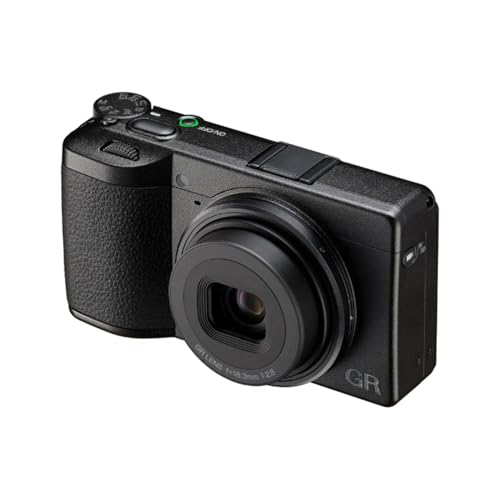
Ricoh GR IV 25.7MP APS-C
Best for: High-resolution compact photography
- Sensor Resolution
- 25.7MP
- Sensor Size
- APS C
- Maximum Aperture
- F2.8
- Image Stabilization
- 5 axis sensor shift
- Color
- Black
- Weight
- 1.4 pounds
This camera features a 25.7MP APS-C sensor and an 18.3mm F2.8 lens. It includes 5-axis sensor shift stabilization and fast hybrid autofocus. The built-in 53GB memory and WiFi help you share images quickly. You get sharp details and reduced blur in various lighting. This model suits you if you want high resolution and reliable stabilization in a compact body.
- 25.7MP APS-C CMOS sensor for high resolution
- 18.3mm F2.8 wide-angle lens for sharp images
- 5-axis sensor shift stabilization reduces blur
- Hybrid autofocus combines phase and contrast detection
- 53GB internal memory for storage
- Heavier build at 1.4 pounds
- Fixed F2.8 maximum aperture limits low-light flexibility
- You need high-resolution 25.7MP images
- You want built-in stabilization for sharper shots
- You prefer carrying less external memory
- You require a faster maximum aperture than F2.8
- You need a lighter camera than 1.4 pounds
- You prefer interchangeable lenses over a fixed glass
Verdict: Ricoh GR IV F2.8 25.7MP fits photographers who prioritize image detail and stabilization. It is a solid choice for those who value built-in storage and a fixed wide-angle lens.

Ricoh GR IV APS-C Compact Camera
Best for: Pocketable wide-angle photography
- Sensor Resolution
- 25.74MP
- Sensor Size
- APS-C
The Ricoh GR IV is a compact digital camera featuring a 25.74MP APS-C sensor. It includes the GA-3 lens adapter, which automatically detects the GW-4 wide-conversion lens. This setup optimizes cropping and image stabilization for edge-to-edge sharpness. The camera is designed to fit easily in your pocket. It suits users who prioritize portability and high-resolution imaging in a small form factor.
- 25.74MP back-illuminated APS-C CMOS sensor
- GA-3 adapter automatically optimizes cropping and stabilization
- Ultra-compact design fits in your pocket
- 21mm focal length equivalent
- Requires the separate GA-3 lens adapter for wide-conversion functionality
- Uses the GW-4 wide-conversion lens which is sold separately
- You want a pocketable camera with high resolution
- You need automatic cropping and stabilization for wide-angle shots
- You prefer a fixed wide-angle lens setup
- You want to use tele-conversion lenses without buying extra gear
- You prefer a larger sensor than APS-C
- You want to attach 49mm filters without an adapter
Verdict: Ricoh GR IV with GA-3 Lens Adapter is a compact solution for photographers who value portability and sharp wide-angle images. It fits users who want automatic lens optimization without manual adjustments.
Specifications side by side
| Spec | Ricoh GR IV 25.7MP APS-C | Ricoh GR IV APS-C Compact Camera |
|---|---|---|
| Sensor Resolution | 25.7MP | 25.74MP |
| Sensor Size | APS C | APS-C |
| Maximum Aperture | F2.8 | – |
| Image Stabilization | 5 axis sensor shift | – |
| Color | Black | – |
| Weight | 1.4 pounds | – |
| Model | Ricoh GR IV | GR IV |
Frequently asked questions
What is the main difference between the Ricoh GR IV F2.8 25.7MP and the standard GR IV?
The primary distinction lies in the lens configuration and internal storage. The first model features a fixed 18.3mm lens with an f/2.8 aperture and includes 53GB of internal memory. The second option is described as a compact solution that works with the GA-3 Lens Adapter, offering automatic lens optimization without requiring manual adjustments from the user.
Does the Ricoh GR IV F2.8 25.7MP have internal storage?
Yes, this specific model includes 53GB of internal memory. This feature allows you to start shooting immediately without needing to carry a separate memory card. It provides a convenient storage solution for photographers who prefer a streamlined setup and want to avoid the hassle of managing removable media during their shoots.
What autofocus system does the Ricoh GR IV F2.8 25.7MP use?
It utilizes a hybrid autofocus system. This technology combines phase detection and contrast detection methods to achieve quick and accurate focusing. This setup helps ensure sharp images by leveraging the speed of phase detection while maintaining the precision of contrast detection across various shooting conditions and subjects.
Is the Ricoh GR IV APS-C Compact Camera compatible with lens adapters?
Yes, this model is designed to work with the GA-3 Lens Adapter. This compatibility allows for automatic lens optimization, which adjusts camera settings to match the attached lens. You benefit from this seamless integration without needing to perform manual adjustments, ensuring consistent image quality across different lens configurations.
What is the weight of the Ricoh GR IV F2.8 25.7MP?
The camera weighs 1.4 pounds. This weight contributes to its classification as a solid choice for photographers who prioritize image detail and stabilization. The build supports its role as a high-resolution compact photography tool, balancing portability with the robust features needed for detailed image capture.
Who is the Ricoh GR IV F2.8 25.7MP best suited for?
It is ideal for photographers who prioritize image detail and stabilization. The fixed wide-angle lens and built-in storage make it a practical choice for those who value convenience and optical quality. It fits users who want a reliable tool for high-resolution compact photography without the need for additional accessories.
What is the best use case for the Ricoh GR IV APS-C Compact Camera?
This camera is best for pocketable wide-angle photography. Its compact design makes it easy to carry, while the focus on sharp wide-angle images suits street and travel photography. It fits users who want automatic lens optimization and a streamlined experience without the complexity of manual lens adjustments.

