As Amazon Associates, we earn from qualifying purchases. This means we may receive a small commission at no extra cost to you if you click through and make a purchase.
As an Amazon Associate we earn from qualifying purchases. Links on this page are affiliate links.
The tamron vs rokinon camera lens debate often centers on distinct optical goals. Both brands deliver sharp optics for photography, but their designs serve different needs. The Tamron 24-70mm F/2.8 G2 is a versatile zoom lens with image stabilization, ideal for dynamic shooting. The Rokinon 135mm F2.0 is a prime telephoto lens optimized for low light and portrait work. You must choose based on whether you need variable focal length or a fixed, fast aperture.
Lens Type
Zoom
Telephoto Prime
Focal Length
24-70mm
135mm
Maximum Aperture
f/2.8
f/2.0
Image Stabilization
Yes (5 stops)
Not listed
Intended Use
Portraits, Landscapes
Video
Choose the first if
- You need a versatile range from wide to short telephoto for landscapes and general photography.
- You require built-in image stabilization to shoot handheld in lower light conditions.
- You prioritize fast and accurate autofocus for dynamic shooting scenarios.
Choose the second if
- You want a faster maximum aperture for better low-light performance and background blur.
- You are shooting portraits or subjects that benefit from a fixed 135mm focal length.
- You are looking for a lens specifically suited for video work with smooth optics.
Verdict
The Tamron 24-70mm F/2.8 G2 is the better choice for photographers who need flexibility and stabilization across various shooting situations. The Rokinon 135mm F2.0 suits those who prioritize a fast aperture for portraits or video at a single focal length. Your decision depends on whether versatility or low-light speed matters more to you.
Zoom Versatility Versus Telephoto Reach
Focal length range
Edge: Tamron 24-70mm F/2.8 G2 for Nikon
The Tamron 24-70mm F/2.8 G2 offers a versatile zoom range. This focal length covers wide-angle to short telephoto perspectives. You can use it for landscapes, portraits, and general photography. The Rokinon 135mm F2.0 is a fixed focal length telephoto lens. It provides a narrower angle of view. On full frame cameras, the angle is 18.8 degrees. On APS-C sensors, it narrows to 12.4 degrees. The Tamron adapts to changing compositions. The Rokinon requires you to move physically to frame your shot. The zoom range of the Tamron provides more flexibility for varied subjects.
Maximum aperture
Edge: Rokinon 135mm f/2.0 Telephoto Lens
Aperture controls light intake and depth of field. The Rokinon lens features a maximum aperture of f/2.0. This wide opening allows more light than the Tamron. It also creates a shallower depth of field for background separation. The Tamron 24-70mm G2 has a maximum aperture of f/2.8. While still fast, it lets in less light than f/2.0. The Rokinon aperture remains constant at f/2.0 throughout its focal length. The Tamron maintains f/2.8 across its zoom range. For low-light situations or creamy bokeh, the Rokinon offers a technical advantage in light gathering capability.
Image stabilization
Edge: Tamron 24-70mm F/2.8 G2 for Nikon
Image stabilization helps reduce camera shake in photos and videos. The Tamron lens includes dedicated Vibration Compensation (VC) technology. It provides up to 5 CIPA-rated stops of stabilization. This allows for sharper handheld shots in lower light. The Rokinon 135mm lens data does not list image stabilization. You must rely on your camera body or steady hands. The Tamron’s built-in stabilization is a significant practical benefit. It compensates for movement without adding bulk to the camera body. The Rokinon lacks this specific feature in its specifications.
Minimum focus distance
Edge: Tamron 24-70mm F/2.8 G2 for Nikon
Minimum focus distance determines how close you can get to a subject. The Tamron lens focuses as close as 0.38 meters, or 15 inches. This allows for tighter framing of details and portraits. The Rokinon lens has a minimum focusing distance of 2.6 feet. This is approximately 0.79 meters. The Tamron allows you to get significantly closer to your subject. This closer proximity helps isolate subjects from busy backgrounds. The Rokinon requires more distance, which may limit your composition options for close-up work.
Recommended usage
Edge: Tie
Intended use guides lens selection for specific tasks. The Tamron is recommended for general photography, including portraits and landscapes. Its zoom range supports these varied genres effectively. The Rokinon is recommended for photography and video. Its telephoto perspective suits video work and distant subjects. The Rokinon includes a removable lens hood, useful for outdoor video. The Tamron’s broad range suits dynamic photography. The Rokinon’s fixed focal length suits dedicated video or telephoto photography. Your choice depends on whether you prioritize versatility or specialized reach.
Which lens matches your shooting style
Travelers needing a versatile zoom range
Our pick: Tamron 24-70mm F/2.8 G2 for Nikon
You need a flexible lens for varying compositions. The Tamron 24-70mm F/2.8 G2 covers wide to short telephoto views. It features image stabilization rated at 5 stops. This helps you capture sharp images in low light or while moving. The f/2.8 aperture remains constant across the zoom range for consistent exposure control.
Photographers prioritizing shallow depth of field
Our pick: Rokinon 135mm f/2.0 Telephoto Lens
You want isolated subjects with blurred backgrounds. The Rokinon 135mm F2.0 offers a wide f/2.0 maximum aperture. This allows more light and stronger background separation. The fixed focal length ensures optical sharpness. It includes an extra-low dispersion element to reduce chromatic aberrations for cleaner images.
Video creators seeking fast autofocus
Our pick: Tamron 24-70mm F/2.8 G2 for Nikon
Smooth focus transitions matter for your video work. The Tamron lens uses a dedicated MPU for fast and accurate autofocus. It also includes a VC auto detect mode for panning shots. The image stabilization further stabilizes handheld video footage. These specs help you maintain professional quality during dynamic recording sessions.
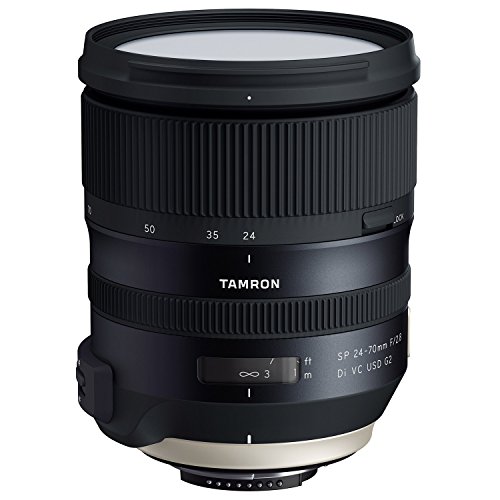
Tamron 24-70mm F/2.8 G2 for Nikon
Best for: Nikon photographers needing versatile zoom
- Lens Mount
- Nikon
- Focal Length
- 24-70mm
- Maximum Aperture
- f/2.8
- Lens Type
- Zoom
- Minimum Focus Distance
- 0.38 m (15 in)
- Recommended Usage
- Photography
This Tamron zoom lens offers a 24-70mm focal range with a constant f/2.8 maximum aperture. It includes 5 CIPA-rated stops of image stabilization and a fluorine coating for moisture resistance. The lens weighs 1.98 pounds and measures 4.3 inches in length. It suits photographers needing versatile focal lengths for portraits and landscapes on Nikon cameras.
- 5 CIPA-rated stops of image stabilization
- Constant f/2.8 maximum aperture
- 24-70mm versatile zoom range
- Fluorine coating for moisture resistance
- Heavier build at 1.98 pounds
- Longer length of 4.3 inches
- Fixed 24-70mm focal length range
- You need a standard zoom for portraits
- You shoot in variable lighting conditions
- You use Nikon mount cameras
- You prefer ultra-compact gear
- You need telephoto reach beyond 70mm
- You shoot exclusively on Canon bodies
Verdict: Tamron 24-70mm F/2.8 G2 Zoom Lens provides a reliable focal range with strong stabilization for Nikon users. It fits those prioritizing aperture speed and image control over minimal weight.
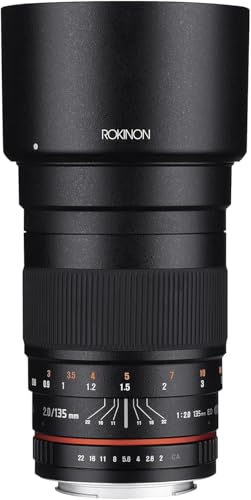
Rokinon 135mm f/2.0 Telephoto Lens
Best for: Canon DSLR portrait and low-light photography
- Lens Mount
- Canon
- Focal Length
- 135mm
- Maximum Aperture
- F2.0
- Sensor Format
- Full frame, APS-C
- Lens Type
- Telephoto
- Minimum Focus Distance
- 2.6 ft.
The Rokinon 135mm f/2.0 is a manual telephoto lens for Canon DSLRs. It features an f/2.0 maximum aperture and one extra-low dispersion element to reduce chromatic aberration. The lens covers full-frame and APS-C sensors with a 18.8-degree angle of view. Weighing 1.8 pounds, it includes a removable hood and 9-blade diaphragm. This optic suits photographers seeking fast glass for portraits or low-light work.
- f/2.0 maximum aperture for low-light performance
- Extra-low dispersion element reduces chromatic aberration
- Full frame and APS-C compatibility
- 9-blade diaphragm for smooth bokeh
- Heavier at 1.8 pounds compared to lighter alternatives
- Manual focus only with no image stabilization
- Fixed 135mm focal length limits versatility
- You need a fast aperture for portrait photography
- You shoot with Canon DSLRs on full frame or APS-C bodies
- You prefer manual control over autofocus systems
- You require autofocus for fast-moving subjects
- You need a zoom lens for variable framing
- You prioritize lightweight gear for travel
Verdict: Rokinon 135mm f/2.0 ED UMC Telephoto delivers sharp images with a bright f/2.0 aperture, making it ideal for Canon users seeking dedicated telephoto performance for portraits or low-light scenarios.
Specifications side by side
| Spec | Tamron 24-70mm F/2.8 G2 for Nikon | Rokinon 135mm f/2.0 Telephoto Lens |
|---|---|---|
| Lens Mount | Nikon | Canon |
| Focal Length | 24-70mm | 135mm |
| Maximum Aperture | f/2.8 | F2.0 |
| Sensor Format | – | Full frame, APS-C |
| Lens Type | Zoom | Telephoto |
| Minimum Focus Distance | 0.38 m (15 in) | 2.6 ft. |
| Recommended Usage | Photography | Photography, Photography & Video |
| Color | Black | Black |
| Intended Use | Portraits, Landscapes | Video |
| Dimensions | 4.3 × 3.5 × 3.5 inches | 3.2 × 4.09 × 4.09 inches |
| Weight | 1.98 pounds | 1.8 pounds |
| Size | Nikon | 77mm |
| Model | AFA032N700 | 135M-C |
Frequently asked questions
Does the Tamron 24-70mm G2 have image stabilization?
Yes, this lens includes strong stabilization features. It helps you capture sharp images in lower light or when shooting handheld. This is particularly useful for photographers who prioritize image control and steady shots without needing a tripod for every situation.
What is the maximum aperture of the Rokinon 135mm lens?
The Rokinon 135mm f/2.0 ED UMC Telephoto has a maximum aperture of f/2.0. This wide opening allows more light to reach the sensor, making it ideal for low-light scenarios. It also helps create a shallow depth of field for portraits.
Is the Tamron 24-70mm suitable for landscape photography?
Yes, the Tamron 24-70mm F/2.8 G2 is intended for landscapes and portraits. Its 24-70mm focal length provides a versatile range. You can capture wide scenes at 24mm and tighter compositions at 70mm, making it a reliable tool for various photography styles.
How much does the Tamron 24-70mm G2 weigh?
The Tamron 24-70mm F/2.8 G2 for Nikon weighs 1.98 pounds. This weight supports its robust build and internal mechanisms. It fits those prioritizing aperture speed and image control over minimal weight, offering a solid feel during extended shooting sessions.
Can the Rokinon 135mm lens be used for video?
Yes, the Rokinon 135mm f/2.0 is recommended for photography and video. Its fixed focal length and bright aperture allow for consistent framing and good light gathering. This makes it a dedicated telephoto option for users seeking specific performance in both stills and motion.
What mount does the Tamron 24-70mm G2 use?
This lens is designed for Nikon mounts. It is specifically labeled as the Tamron 24-70mm F/2.8 G2 for Nikon. Ensure your camera body has a Nikon mount to use this lens. It provides a reliable focal range for Nikon users needing versatility.
Does the Rokinon 135mm have a variable aperture?
No, the Rokinon 135mm f/2.0 has a fixed aperture. It maintains f/2.0 across its entire focal range because it is a prime lens. This consistency ensures predictable exposure settings, which is beneficial for portrait and low-light photography where light control is key.


