As Amazon Associates, we earn from qualifying purchases. This means we may receive a small commission at no extra cost to you if you click through and make a purchase.
As an Amazon Associate we earn from qualifying purchases. Links on this page are affiliate links.
When evaluating sigma vs rokinon camera lens options, you face two distinct optical paths. Both brands build glass for Canon DSLR bodies, but their designs serve opposite ends of the focal range. The Sigma 10-20mm f/3.5 is a super-wide zoom, while the Rokinon 135mm f/2.0 is a prime telephoto. This comparison breaks down how their specs, weight, and intended uses differ to help you pick the right tool for your specific shooting needs.
Lens Type
Super Wide Angle
Telephoto
Focal Length
10-20mm
135mm
Maximum Aperture
f/3.5
f/2.0
Weight
1.15 pounds
1.8 pounds
Sensor Format
not listed
Full frame, APS-C
Minimum Focus Distance
not listed
2.6 ft.
Choose the first if
- You need a versatile wide-angle zoom for landscapes or architecture.
- You prefer a lighter lens that is easier to carry for long periods.
- You shoot with Canon DSLRs and want a constant f/3.5 aperture.
Choose the second if
- You require a fast f/2.0 aperture for low-light situations or shallow depth of field.
- You want a fixed focal length lens with high optical sharpness.
- You need a lens compatible with both full-frame and APS-C sensor bodies.
Verdict
Choose the Sigma 10-20mm if you need a wide-angle zoom for expansive scenes and value a lighter package. Select the Rokinon 135mm if you prioritize a fast aperture for portraits or low-light telephoto work. These lenses serve very different purposes, so your choice depends on your focal length requirements.
Sigma vs Rokinon Lens Specs
Focal Length Range
Edge: Sigma 10-20mm f/3.5 Super Wide Angle Lens
The Sigma 10-20mm f/3.5 EX DC HSM offers a versatile super-wide zoom range, covering 10 to 20mm. This flexibility allows you to capture expansive landscapes or tight interiors without changing lenses. In contrast, the Rokinon 135mm f/2.0 ED UMC is a prime telephoto lens with a fixed focal length of 135mm. It is designed for specific telephoto applications rather than variable framing. You must choose between the Sigma’s adaptable wide-angle zoom and the Rokinon’s specialized fixed telephoto reach. The Sigma provides broader compositional options, while the Rokinon targets a narrow, dedicated field of view.
Maximum Aperture
Edge: Rokinon 135mm f/2.0 Telephoto Lens
Aperture determines light gathering and depth of field control. The Sigma 10-20mm maintains a constant maximum aperture of f/3.5 throughout its entire zoom range. This consistency is useful for exposure stability while zooming. The Rokinon 135mm features a significantly wider maximum aperture of f/2.0. This wider opening allows more light to reach the sensor, enabling faster shutter speeds in low light. It also creates a shallower depth of field for subject isolation. The Rokinon’s f/2.0 specification offers a clear advantage for low-light performance and background blur compared to the Sigma’s f/3.5.
Lens Weight
Edge: Sigma 10-20mm f/3.5 Super Wide Angle Lens
Portability matters for handheld shooting and travel. The Sigma 10-20mm lens weighs 1.15 pounds. This makes it the lighter option of the two, reducing fatigue during long sessions. The Rokinon 135mm lens weighs 1.8 pounds. It is heavier due to its telephoto glass construction. If you prioritize a lighter kit for walking or travel, the Sigma is the more manageable choice. The weight difference is noticeable, with the Sigma being nearly half a pound lighter. You should consider how much weight you are willing to carry when deciding between these two distinct optical designs.
Sensor Format Compatibility
Edge: Rokinon 135mm f/2.0 Telephoto Lens
Sensor format compatibility affects the effective field of view. The Rokinon 135mm is explicitly listed as compatible with both full frame and APS-C sensor formats. It provides an 18.8-degree angle of view on full frame and 12.4 degrees on APS-C. The Sigma 10-20mm is labeled as a DC lens, which typically indicates it is optimized for APS-C sensors. The data does not explicitly state full-frame compatibility for the Sigma, implying it may have vignetting or is designed primarily for crop sensors. The Rokinon offers verified versatility across both major sensor formats, giving it an edge for users with different camera bodies.
Included Accessories
Edge: Tie
Included accessories can add value to your purchase. The Sigma 10-20mm comes with a petal-type lens hood supplied in the box. This hood helps reduce flare and protect the front element. The Rokinon 135mm also includes a removable lens hood. Both brands provide essential protection against stray light. The Sigma’s hood is described as petal-type, suited for its wide angle. The Rokinon’s hood is removable, offering flexibility. Since both lenses include a hood, this aspect is a tie. You receive necessary optical protection with either choice, though the specific design of the hood varies by lens type.
Which lens fits your shooting style
Landscape and interior photographers
Our pick: Sigma 10-20mm f/3.5 Super Wide Angle Lens
You need a super-wide zoom to capture expansive scenes or tight interiors. The Sigma 10-20mm f/3.5 covers 10 to 20mm with a constant aperture. This flexibility lets you frame broad vistas or cramped rooms without swapping glass. The 10-20mm range is ideal for architectural and travel shots where you need to fit more into the frame.
Portrait and telephoto shooters
Our pick: Rokinon 135mm f/2.0 Telephoto Lens
You require a dedicated telephoto lens for portraits or distant subjects. The Rokinon 135mm f/2.0 delivers a fixed focal length with a bright maximum aperture. This allows for shallow depth of field and better low-light performance. The 135mm reach isolates subjects effectively, while the f/2.0 aperture helps you separate your subject from the background in various lighting conditions.
Video creators needing versatility
Our pick: Sigma 10-20mm f/3.5 Super Wide Angle Lens
You are shooting video and need a zoom lens that adapts to changing compositions. The Sigma 10-20mm allows you to adjust your framing on the fly without moving. The continuous zoom range from 10 to 20mm provides creative control over perspective. This is useful for dynamic video work where you cannot easily change your physical position relative to the subject.

Sigma 10-20mm f/3.5 Super Wide Angle Lens
Best for: Canon DSLR wide-angle photography
- Focal Length
- 10-20mm
- Maximum Aperture
- F3.5
- Lens Type
- Super Wide Angle
- Color
- Black
- Dimensions
- 3.46 × 3.43 × 3.43 inches
- Weight
- 1.15 pounds
This Sigma lens is a super-wide angle zoom for Canon DSLRs. It offers a 10-20mm focal length with a constant f/3.5 maximum aperture across the entire range. The build is black and weighs 1.15 pounds. It includes a petal-type hood. You get a versatile wide perspective for landscapes or architecture without changing aperture settings while zooming.
- 10-20mm super-wide focal length range
- Constant f/3.5 maximum aperture
- Includes petal-type hood
- Compact dimensions at 3.43 x 3.46 inches
- Heavier build at 1.15 pounds compared to lighter alternatives
- Maximum aperture of f/3.5 is slower than f/2.0 options
- You need a constant aperture for consistent exposure while zooming
- You shoot landscapes or architecture with Canon DSLRs
- You want a wide angle lens that includes a hood
- You require a faster aperture than f/3.5 for low light
- You prefer a lighter lens under 1 pound
- You use a camera mount other than Canon
Verdict: Sigma 10-20mm f/3.5 Super Wide Angle Lens provides a steady f/3.5 aperture for Canon users. It suits those prioritizing consistent exposure in wide-angle scenarios over speed or minimal weight.
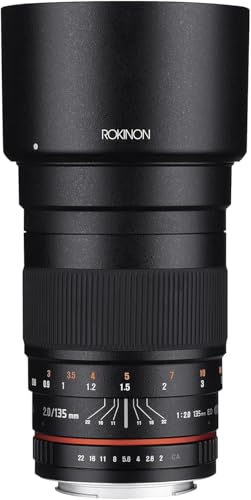
Rokinon 135mm f/2.0 Telephoto Lens
Best for: Canon telephoto photography and video
- Lens Mount
- Canon
- Focal Length
- 135mm
- Maximum Aperture
- F2.0
- Sensor Format
- Full frame, APS-C
- Lens Type
- Telephoto
- Minimum Focus Distance
- 2.6 ft.
The Rokinon 135mm f/2.0 is a telephoto lens for Canon DSLRs. It features a fast f/2.0 maximum aperture and an Ultra Multi-Coated optical design. The lens includes one extra-low dispersion element to reduce chromatic aberrations. It focuses as close as 2.6 feet and weighs 1.8 pounds. This lens suits photographers and videographers seeking sharp telephoto performance on full frame or APS-C bodies.
- Fast f/2.0 maximum aperture for low light
- Ultra Multi-Coated optics for clarity
- Extra-low dispersion element reduces color fringing
- 9-blade diaphragm for smooth bokeh
- Heavier at 1.8 pounds compared to lighter alternatives
- Longer length at 3.2 inches adds bulk to the setup
- Fixed focal length limits zoom flexibility
- You need a fast aperture for portrait or video work
- You shoot with Canon DSLR cameras
- You prefer manual focus precision
- You require an autofocus system
- You need a zoom lens for variable framing
- You prioritize ultra-lightweight gear for travel
Verdict: Rokinon 135mm f/2.0 Telephoto Lens delivers sharp telephoto images with a bright aperture. It fits Canon users who value optical quality and manual control over zoom convenience.
Specifications side by side
| Spec | Sigma 10-20mm f/3.5 Super Wide Angle Lens | Rokinon 135mm f/2.0 Telephoto Lens |
|---|---|---|
| Lens Mount | – | Canon |
| Focal Length | 10-20mm | 135mm |
| Maximum Aperture | F3.5 | F2.0 |
| Sensor Format | – | Full frame, APS-C |
| Lens Type | Super Wide Angle | Telephoto |
| Minimum Focus Distance | – | 2.6 ft. |
| Recommended Usage | – | Photography, Photography & Video |
| Color | Black | Black |
| Intended Use | – | Video |
| Dimensions | 3.46 × 3.43 × 3.43 inches | 3.2 × 4.09 × 4.09 inches |
| Weight | 1.15 pounds | 1.8 pounds |
| Model | 202101 | 135M-C |
| Size | – | 77mm |
Frequently asked questions
Which lens is better for wide-angle photography?
The Sigma 10-20mm f/3.5 is the clear choice for wide-angle work. It offers a versatile zoom range from 10 to 20mm, allowing you to capture expansive landscapes or tight interiors. This flexibility lets you frame broad vistas without changing lenses, making it ideal for Canon DSLR users prioritizing consistent exposure in wide scenarios.
Is the Rokinon 135mm lens good for portraits?
Yes, the Rokinon 135mm f/2.0 is well-suited for portrait photography. Its telephoto focal length allows you to isolate subjects with a pleasing background blur. The bright f/2.0 aperture lets in more light, which helps achieve sharp images in lower light conditions while maintaining manual control over your focus and exposure settings.
Does the Sigma lens have a constant aperture?
Yes, the Sigma 10-20mm f/3.5 features a constant f/3.5 aperture throughout its zoom range. This means you get consistent exposure settings whether you are shooting at 10mm or 20mm. This stability is helpful for video work or photography where you need predictable light intake without adjusting your camera settings as you zoom.
How heavy is the Sigma 10-20mm lens?
The Sigma 10-20mm f/3.5 weighs 1.15 pounds. Its dimensions are 3.43 inches in width and height, with a length of 3.46 inches. This relatively compact size makes it manageable for handheld shooting, though it is slightly heavier than some ultra-compact alternatives. You can carry it comfortably during long photography sessions.
What is the filter size for the Rokinon lens?
The Rokinon 135mm f/2.0 uses a 77mm filter thread. This standard size allows you to use widely available filters for various effects. You can easily find screw-on filters for this size, making it convenient to add UV protection or creative filters without needing specialized or hard-to-find accessories.
Can I use the Rokinon lens for video?
Yes, the Rokinon 135mm f/2.0 is recommended for video usage. Its manual focus design gives you precise control over focus pulls, which is essential for cinematic shots. The bright aperture also helps maintain a shallow depth of field, separating your subject from the background for a professional look in your video projects.
Which lens is lighter for travel?
The Sigma 10-20mm f/3.5 is lighter than the Rokinon option. It weighs 1.15 pounds, while the Rokinon 135mm f/2.0 weighs 1.8 pounds. If you are traveling and want to minimize pack weight, the Sigma lens offers a more portable solution without sacrificing the wide-angle capabilities needed for landscape or architecture photography.


