As Amazon Associates, we earn from qualifying purchases. This means we may receive a small commission at no extra cost to you if you click through and make a purchase.
As an Amazon Associate we earn from qualifying purchases. Links on this page are affiliate links.
When you compare rokinon vs LAOWA camera lens options, you are looking at two distinct approaches to manual focus optics. Both brands offer glass designed for full-frame sensors and appeal to photographers who value manual control. The Rokinon 135mm f/2.0 is a telephoto prime, while the LAOWA 100mm f/2.8 is a specialized macro lens. Your choice depends on whether you need reach for portraits or extreme close-up detail for small subjects.
Lens Type
Telephoto
Macro
Focal Length
135mm
100mm
Maximum Aperture
f/2.0
f/2.8
Mount Options
Canon, Nikon, Sony E, Fuji X, Pentax, Micro Four Thirds
Sony E
Maximum Magnification
not listed
2x
Weight
1.8 pounds
1.41 pounds
Choose the first if
- You want a longer focal length for portraits or distant subjects.
- You need a lens compatible with Canon, Nikon, or other mounts besides Sony.
- You prefer a wider maximum aperture for better background blur.
Choose the second if
- You require 2x magnification for extreme close-up macro photography.
- You shoot exclusively with Sony E-mount cameras.
- You want a lighter lens that weighs under 1.5 pounds.
Verdict
Choose the Rokinon if you need a versatile telephoto lens with multiple mount options and a wider aperture. Pick the LAOWA if your primary goal is high-magnification macro work on a Sony E-mount body. Both lenses serve specific niches well without overlapping in function.
Telephoto Versus Macro Lens Comparison
Lens Type and Use
Edge: Tie
The Rokinon 135mm f/2.0 is a telephoto lens designed for general photography and video. It offers a broad angle of view on full-frame cameras and suits subjects at a distance. The LAOWA 100mm f/2.8 is a dedicated macro lens. It provides 2x magnification, allowing you to capture extreme close-up details of small subjects. This makes it ideal for product photography or nature shots. While the Rokinon handles portraits and distant scenes, the LAOWA specializes in intimate, high-magnification work. You should choose based on whether you need reach or extreme close-up detail.
Maximum Aperture
Edge: Rokinon 135mm f/2.0 Telephoto Lens
Aperture controls light intake and background blur. The Rokinon lens features a maximum aperture of f/2.0. This wider opening allows more light to reach the sensor, which is helpful in lower light conditions. It also creates a shallower depth of field for stronger background separation. The LAOWA lens has a maximum aperture of f/2.8. This is a smaller opening, meaning it lets in less light compared to the Rokinon. However, it still provides a decent amount of background blur for macro work. If low-light performance is your priority, the Rokinon holds an advantage here.
Mount Compatibility
Edge: Rokinon 135mm f/2.0 Telephoto Lens
Mount compatibility determines which cameras you can use. The Rokinon 135mm f/2.0 is listed with a Canon mount in its key specs. However, the variations section shows it is also available for Pentax, Micro Four Thirds, Sony E, Nikon, and Fuji X. This wide range gives you flexibility across many systems. The LAOWA 100mm f/2.8 is specified for the Sony E mount. It is designed specifically for Sony cameras. If you use a Canon, Nikon, or other system, the Rokinon is the only viable option from this pair. For Sony users, both lenses are compatible.
Sensor Format
Edge: Rokinon 135mm f/2.0 Telephoto Lens
Sensor format affects image coverage and crop factors. Both lenses support full-frame sensors. The Rokinon 135mm f/2.0 also explicitly supports APS-C sensors. On APS-C bodies, it provides a narrower angle of view, effectively acting as a longer telephoto. The LAOWA 100mm f/2.8 is listed for full-frame use. The data does not confirm APS-C compatibility for the LAOWA lens. This makes the Rokinon more versatile if you own multiple camera bodies with different sensor sizes. You get broader coverage with the Rokinon option.
Weight and Size
Edge: Tie
Physical dimensions impact portability and balance. The Rokinon 135mm f/2.0 weighs 1.8 pounds and measures 3.2 inches in length. It is a heavier, longer lens due to its telephoto design. The LAOWA 100mm f/2.8 weighs 1.41 pounds and is 6.1 inches long. It is lighter but longer. The Rokinon is more compact in length, which might be easier to handle for handheld telephoto shots. The LAOWA is lighter, reducing fatigue during long macro sessions. Both have manageable footprints, but the Rokinon is shorter while the LAOWA is lighter.
Which Lens Fits Your Shooting Style
Macro photographers needing high magnification
Our pick: Laowa 100mm f/2.8 2x Macro Lens
The Laowa 100mm f/2.8 delivers 2x magnification, allowing you to capture extreme close-up details. This ultra-macro lens is ideal for insects, textures, and small objects. Its APO design helps control chromatic aberration for cleaner images. You get a dedicated macro tool rather than a general-purpose telephoto.
Shooters wanting faster aperture for portraits
Our pick: Rokinon 135mm f/2.0 Telephoto Lens
The Rokinon 135mm f/2.0 offers a wider maximum aperture than the Laowa. This lets in more light for low-light situations and creates stronger background blur. The 135mm focal length is classic for portraits and telephoto work. You gain versatility for general photography and video with a faster lens.
Users with Sony E mount cameras
Our pick: Laowa 100mm f/2.8 2x Macro Lens
The Laowa lens is explicitly designed for Sony E mount systems. If you own Sony cameras, this lens provides native compatibility without adapters. The 100mm focal length suits full-frame Sony bodies well. You get a lens optimized for your specific camera system's mount and sensor format.
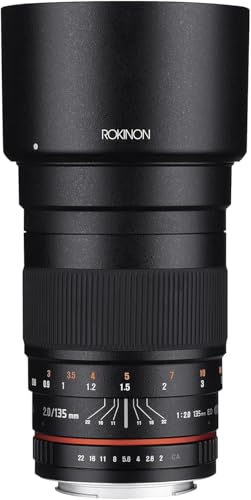
Rokinon 135mm f/2.0 Telephoto Lens
Best for: Portrait and low-light photography on Canon cameras
- Lens Mount
- Canon
- Focal Length
- 135mm
- Maximum Aperture
- F2.0
- Sensor Format
- Full frame, APS-C
- Lens Type
- Telephoto
- Minimum Focus Distance
- 2.6 ft.
This Rokinon 135mm f/2.0 telephoto lens delivers sharp images with an ultra-wide maximum aperture. It features one extra-low dispersion element to reduce chromatic aberrations and nine diaphragm blades for smooth bokeh. The lens is compatible with full-frame and APS-C sensors, offering a 18.8-degree angle of view on full-frame bodies. It focuses as close as 2.6 feet and includes a removable lens hood. This manual focus optic suits photographers seeking fast glass for portraits or low-light scenes.
- f/2.0 maximum aperture for low light and background separation
- ED element reduces chromatic aberrations
- 9-blade diaphragm for smoother bokeh
- Compatible with full-frame and APS-C sensors
- Heavier at 1.8 pounds compared to lighter alternatives
- Longer length at 3.2 inches
- Minimum focus distance of 2.6 feet is farther than macro options
- You want a fast aperture for portrait photography
- You shoot with Canon DSLR or mirrorless cameras
- You need a lens for video work with shallow depth of field
- You require autofocus capabilities
- You need a macro lens for extreme close-ups
- You prefer a lightweight travel lens under 1 pound
Verdict: Rokinon 135mm f/2.0 Telephoto Lens is a solid manual focus option for Canon users who prioritize aperture speed and optical quality over compact size. It fits those who want to isolate subjects with a fast f/2.0 lens without the bulk of heavier professional glass.

Laowa 100mm f/2.8 2x Macro Lens
Best for: Sony full-frame macro photography
- Lens Mount
- Sony E
- Focal Length
- 100mm
- Maximum Aperture
- f/2.8
- Sensor Format
- Full Frame
- Lens Type
- Macro
- Maximum Magnification
- 2x
The Laowa 100mm f/2.8 2X Ultra Macro APO lens is designed for Sony E mount cameras on full-frame sensors. It offers a 100mm focal length with a maximum aperture of f/2.8. The key feature is its 2x maximum magnification, allowing for extreme close-up detail. The lens has a 12-element structure in 10 groups. It weighs 1.41 pounds and measures 6.1 inches in length. This tool suits photographers needing high-reproduction macro work.
- 2x maximum magnification for extreme close-ups
- f/2.8 maximum aperture for low light
- 12-element lens structure for image quality
- Designed for full-frame Sony E mount
- Heavier at 1.41 pounds compared to lighter options
- Longer length of 6.1 inches requires more space
- 100mm focal length limits wide-angle utility
- You need 2x magnification for detailed macro shots
- You shoot with Sony E mount full-frame cameras
- You prioritize aperture and magnification over portability
- You use Canon or Nikon DSLR systems
- You need a wide-angle focal length
- You require a lighter lens for travel
Verdict: Laowa 100mm f/2.8 2X Macro Lens delivers high magnification for Sony users. It fits photographers who need detailed close-ups and can handle its weight. It is not for wide-angle or lightweight needs.
Specifications side by side
| Spec | Rokinon 135mm f/2.0 Telephoto Lens | Laowa 100mm f/2.8 2x Macro Lens |
|---|---|---|
| Lens Mount | Canon | Sony E |
| Focal Length | 135mm | 100mm |
| Maximum Aperture | F2.0 | f/2.8 |
| Sensor Format | Full frame, APS-C | Full Frame |
| Lens Type | Telephoto | Macro |
| Minimum Focus Distance | 2.6 ft. | – |
| Maximum Magnification | – | 2x |
| Recommended Usage | Photography, Photography & Video | – |
| Color | Black | Black, white, blue, grey, yellow, green |
| Intended Use | Video | – |
| Dimensions | 3.2 × 4.09 × 4.09 inches | 6.1 × 2.83 × 2.83 inches |
| Weight | 1.8 pounds | 1.41 pounds |
| Size | 77mm | pet |
| Model | 135M-C | VE10028FE |
Frequently asked questions
Which brand is better for portrait photography?
Rokinon is the better choice for portraits. Its 135mm f/2.0 lens provides a telephoto focal length that isolates subjects effectively. The fast f/2.0 aperture allows for shallow depth of field, blurring backgrounds. This setup is ideal for Canon users seeking clear subject separation without heavy professional glass.
Is LAOWA suitable for macro photography?
Yes, LAOWA excels in this area. The 100mm f/2.8 lens offers 2x magnification, capturing extreme close-up details of insects or textures. It is designed for Sony full-frame cameras. This high magnification makes it a specialized tool for photographers who need detailed macro capabilities rather than general shooting.
How do the weights compare between these lenses?
The Rokinon 135mm is heavier at 1.8 pounds. The LAOWA 100mm macro weighs 1.41 pounds. Both are substantial pieces of equipment. You should consider your camera support needs. The Rokinon offers more weight, which might provide stability, while the LAOWA is slightly lighter for handheld macro work.
Can I use these lenses for video recording?
Rokinon explicitly lists its 135mm lens for photography and video. The smooth manual focus and telephoto view suit video subjects at a distance. LAOWA focuses on macro photography. While manual focus works for video, the Rokinon is specifically noted for its suitability in video production contexts alongside stills.
What mount systems are supported by these lenses?
The Rokinon 135mm is designed for Canon cameras. The LAOWA 100mm macro uses a Sony E mount. You must ensure your camera body matches the specific mount. Each brand targets different ecosystems. Check your camera brand before purchasing to ensure physical compatibility and proper communication with the lens.
Do these lenses support full-frame sensors?
Yes, both lenses are designed for full-frame sensors. The LAOWA explicitly states full-frame support. The Rokinon 135mm is also intended for full-frame use. This ensures the image circle covers the entire sensor area. You will get the full resolution and field of view intended by the optical design.
Which lens has a wider maximum aperture?
The Rokinon 135mm has a wider aperture at f/2.0. The LAOWA 100mm macro stops at f/2.8. A wider aperture allows more light, aiding low-light performance. It also creates a shallower depth of field. If you need more background blur or low-light capability, the Rokinon option is superior.