As Amazon Associates, we earn from qualifying purchases. This means we may receive a small commission at no extra cost to you if you click through and make a purchase.
As an Amazon Associate we earn from qualifying purchases. Links on this page are affiliate links.
When comparing rokinon 135mm f2 0 ed umc vs 14mm f2 8 af wide, you are looking at two distinct optical tools. Both lenses prioritize sharp image quality and include extra-low dispersion elements to control chromatic aberration. They also share a black color scheme and are designed for full-frame sensors. The main difference lies in their focal length and function. One is a telephoto lens for close-up detail, while the other is a wide-angle lens for expansive scenes.
Lens Type
Telephoto
Wide Angle
Focal Length
135mm
14mm
Maximum Aperture
F2.0
f/2.8
Autofocus
Manual focus only
Internal focusing with autofocus motor
Angle of View
18.8 degrees (full frame)
113.9 degrees
Weight
1.8 pounds
1.07 pounds
Choose the first if
- You need a telephoto lens for portraits or distant subjects with a wider maximum aperture of F2.0.
- You prefer manual control and do not require autofocus functionality for your photography.
- You want a lens that offers a narrower field of view for isolating specific details.
Choose the second if
- You require auto-focus capability for quick shooting in dynamic environments like street photography.
- You need a wide-angle lens with a very broad 113.9-degree angle of view for landscapes or interiors.
- You prioritize a lighter, more compact lens that weighs under 1.1 pounds for portability.
Verdict
The Rokinon 135mm F2.0 is the better choice for photographers seeking manual control and a faster aperture for telephoto work. The Rokinon 14mm F2.8 AF is ideal for those who need wide-angle coverage and reliable autofocus for general-purpose shooting.
Telephoto Reach vs Wide Angle Utility
Focal length and field of view
Edge: Tie
The Rokinon 135mm f/2.0 Telephoto Lens is a long telephoto prime with a 135mm focal length. It provides an 18.8-degree angle of view on full-frame cameras and a tighter 12.4-degree view on APS-C sensors. This narrow perspective compresses backgrounds, making it suitable for isolating distant subjects. In contrast, the Rokinon 14mm f/2.8 AF Wide Angle Lens offers a 14mm focal length with a massive 113.9-degree angle of view. This ultra-wide perspective captures expansive landscapes, interiors, and cityscapes with edge-to-edge clarity. You choose the 135mm for compression and the 14mm for breadth.
Autofocus technology
Edge: Rokinon 14mm f/2.8 AF Wide Angle Lens
Autofocus capabilities differ significantly between these two optics. The Rokinon 14mm f/2.8 AF Wide Angle Lens features an internal focusing system with a responsive autofocus motor. It works seamlessly with Sony's phase and contrast detect systems and includes manual focus override for precision control. The Rokinon 135mm f/2.0 Telephoto Lens is described as a manual focus lens in its feature set, lacking any mention of an autofocus motor or electronic contacts for auto-focus operation. If you require automatic focusing, the 14mm is the only viable option.
Maximum aperture and light gathering
Edge: Rokinon 135mm f/2.0 Telephoto Lens
Aperture affects low-light performance and depth of field. The Rokinon 135mm f/2.0 Telephoto Lens has a maximum aperture of f/2.0. This wider opening allows more light to reach the sensor, which is beneficial in dim environments and helps create shallow depth of field for subject separation. The Rokinon 14mm f/2.8 AF Wide Angle Lens has a maximum aperture of f/2.8. While still bright, it gathers less light than the f/2.0 option. The 135mm lens also stops down to f/22, whereas the 14mm aperture range is not specified in the provided data.
Build weight and portability
Edge: Rokinon 14mm f/2.8 AF Wide Angle Lens
Portability matters for travel and handheld shooting. The Rokinon 135mm f/2.0 Telephoto Lens weighs 1.8 pounds and measures 4.09 inches in height and width with a length of 3.2 inches. It is heavier and bulkier. The Rokinon 14mm f/2.8 AF Wide Angle Lens weighs only 1.07 pounds. It measures 3.6 inches in height and width with a length of 3.8 inches. The 14mm lens is significantly lighter, making it easier to carry for extended periods or for street photography where discretion and comfort are priorities.
Optical element construction
Edge: Rokinon 14mm f/2.8 AF Wide Angle Lens
Both lenses use special glass to improve image quality. The Rokinon 135mm f/2.0 Telephoto Lens includes one extra-low dispersion (ED) element to reduce chromatic aberrations and features Rokinon Ultra Multi-Coated (UMC) optics. It uses a nine-blade diaphragm. The Rokinon 14mm f/2.8 AF Wide Angle Lens has a more complex optical formula with 14 elements in 10 groups. This includes three aspherical elements and two ED elements to minimize distortion and improve color accuracy. The 14mm lens has a more intricate internal design to handle wide-angle distortions.
Which Rokinon lens fits your needs?
Telephoto portrait and video shooters
Our pick: Rokinon 135mm f/2.0 Telephoto Lens
Choose the 135mm f/2.0 for its long reach and bright aperture. The f/2.0 maximum aperture allows for better low-light performance and stronger background separation than the wider lens. Its 2.6 ft minimum focus distance helps you get closer to subjects. The 18.8-degree angle of view isolates details effectively for portraits or distant scenes.
Wide angle landscape and interior photographers
Our pick: Rokinon 14mm f/2.8 AF Wide Angle Lens
The 14mm f/2.8 AF offers a massive 113.9-degree angle of view, ideal for expansive landscapes and tight interiors. It features autofocus for quick shooting and includes three aspherical elements to minimize distortion. The compact 1.07-pound weight makes it easier to carry during travel or street photography sessions compared to heavier telephoto options.
Sony E mount users wanting autofocus
Our pick: Rokinon 14mm f/2.8 AF Wide Angle Lens
If you use a Sony E mount camera, this lens provides reliable autofocus via an internal focusing system. It works seamlessly with phase and contrast detect systems. The 14mm focal length captures wide scenes with edge-to-edge clarity. Its weather-resistant aluminum body adds durability, making it a practical choice for outdoor shooting in various conditions.
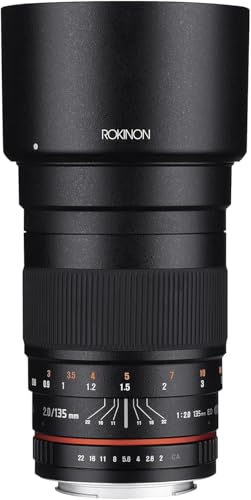
Rokinon 135mm f/2.0 Telephoto Lens
Best for: Canon DSLR portrait and low-light photography
- Lens Mount
- Canon
- Focal Length
- 135mm
- Maximum Aperture
- F2.0
- Sensor Format
- Full frame, APS-C
- Lens Type
- Telephoto
- Minimum Focus Distance
- 2.6 ft.
This Rokinon lens is a 135mm telephoto optic designed for Canon DSLR cameras. It features a bright f/2.0 maximum aperture and an Ultra Multi-Coated (UMC) optical design with one extra-low dispersion element to reduce chromatic aberrations. The lens offers a 18.8-degree angle of view on full-frame sensors and focuses as close as 2.6 feet. It weighs 1.8 pounds and includes a removable lens hood. This build suits photographers seeking sharp, long-range imagery with fast low-light performance.
- Fast f/2.0 maximum aperture for low-light shooting
- ED element reduces chromatic aberrations
- 9-blade diaphragm for smoother bokeh
- Full-frame compatible with 18.8-degree angle of view
- Heavier 1.8-pound build compared to lighter alternatives
- Longer 3.2-inch length limits portability
- Fixed 135mm focal length reduces versatility
- You need a dedicated telephoto lens for portraits
- You shoot in low-light conditions requiring fast apertures
- You use Canon DSLR cameras and want full-frame compatibility
- You require autofocus capabilities for this focal length
- You need a lightweight lens for travel
- You shoot with Sony E-mount cameras exclusively
Verdict: Rokinon 135mm F2.0 Telephoto Lens fits Canon users who prioritize optical sharpness and low-light speed over autofocus convenience. It delivers a specialized long-range perspective ideal for static subjects.

Rokinon 14mm f/2.8 AF Wide Angle Lens
Best for: Sony E-mount wide-angle photography
- Lens Mount
- Sony E
- Focal Length
- 14mm
- Maximum Aperture
- f/2.8
- Sensor Format
- Full Frame
- Lens Type
- Wide Angle
- Color
- Black
This Rokinon 14mm F2.8 lens is a wide-angle option for Sony E-mount full-frame cameras. It features a 113.9° angle of view and an f/2.8 maximum aperture. The optical design includes 14 elements in 10 groups. It weighs 1.07 pounds. You get quiet autofocus and weather-resistant construction. This lens suits landscape and interior photographers needing a compact, fast wide-angle prime.
- 113.9° angle of view for expansive scenes
- f/2.8 aperture for low-light performance
- 14 elements in 10 groups for clarity
- Compact 450g form factor for portability
- Heavier at 1.07 pounds compared to lighter primes
- Fixed 14mm focal length limits versatility
- f/2.8 aperture is slower than f/2.0 options
- You shoot landscapes or architecture on Sony E-mount
- You need a fast aperture for night scenes
- You want a compact wide-angle lens
- You use Canon or Nikon DSLRs
- You need telephoto reach
- You prefer lighter glass under 1 pound
Verdict: Rokinon 14mm F2.8 Wide Angle Lens delivers a bright f/2.8 aperture and wide 113.9° view for Sony E-mount users. It fits photographers prioritizing low-light wide-angle shots over telephoto flexibility.
Specifications side by side
| Spec | Rokinon 135mm f/2.0 Telephoto Lens | Rokinon 14mm f/2.8 AF Wide Angle Lens |
|---|---|---|
| Lens Mount | Canon | Sony E |
| Focal Length | 135mm | 14mm |
| Maximum Aperture | F2.0 | f/2.8 |
| Sensor Format | Full frame, APS-C | Full Frame |
| Lens Type | Telephoto | Wide Angle |
| Minimum Focus Distance | 2.6 ft. | – |
| Recommended Usage | Photography, Photography & Video | – |
| Color | Black | Black |
| Intended Use | Video | – |
| Dimensions | 3.2 × 4.09 × 4.09 inches | 3.8 × 3.6 × 3.6 inches |
| Weight | 1.8 pounds | 1.07 pounds |
| Size | 77mm | 3.7 inches diameter x 3.8 inches length |
| Model | 135M-C | IO14AF-E |
Frequently asked questions
Which lens is lighter and more portable?
The Rokinon 14mm F2.8 AF Wide is the lighter option. It weighs 1.07 pounds, while the 135mm F2.0 Telephoto Lens weighs 1.8 pounds. The 14mm lens also has a smaller physical footprint, measuring 3.6 inches wide compared to the 135mm lens's 4.09-inch width. This makes the 14mm lens easier to carry for travel or handheld shooting.
Does the 14mm lens have autofocus?
Yes, the Rokinon 14mm F2.8 AF Wide includes autofocus capabilities. The model name explicitly includes "AF" to indicate this feature. In contrast, the Rokinon 135mm F2.0 ED UMC Telephoto Lens is a manual focus prime lens. You must adjust focus manually on the 135mm model, whereas the 14mm model automates this process for Sony E-mount users.
What camera mount does the 14mm lens use?
The Rokinon 14mm F2.8 AF Wide is designed for Sony E-mount cameras. Its attributes list the lens mount as Sony E. The Rokinon 135mm F2.0 ED UMC is intended for Canon DSLR systems. You must choose the correct mount version for your specific camera body to ensure proper fit and functionality.
Which lens offers a wider angle of view?
The Rokinon 14mm F2.8 AF Wide provides a significantly wider view. It offers a 113.9-degree angle of view on full-frame sensors. The Rokinon 135mm F2.0 Telephoto Lens has a narrow 18.8-degree angle of view on full-frame cameras. The 14mm lens is suitable for landscapes and architecture, while the 135mm is for distant subjects.
Is the 135mm lens suitable for video?
Yes, the Rokinon 135mm F2.0 ED UMC is recommended for photography and video. Its attributes list its intended use as video. The lens features a bright f/2.0 aperture, which helps in low-light video recording scenarios. It also includes extra-low dispersion elements to reduce color fringing, which is beneficial for maintaining image quality in video production.
What is the maximum aperture of each lens?
The Rokinon 135mm F2.0 Telephoto Lens has a maximum aperture of f/2.0. The Rokinon 14mm F2.8 AF Wide has a maximum aperture of f/2.8. The f/2.0 aperture on the 135mm lens allows more light to enter, which is useful for low-light situations and achieving shallower depth of field compared to the f/2.8 aperture on the 14mm lens.


