As Amazon Associates, we earn from qualifying purchases. This means we may receive a small commission at no extra cost to you if you click through and make a purchase.
As an Amazon Associate we earn from qualifying purchases. Links on this page are affiliate links.
You are looking for panasonic lumix micro four thirds alternatives because your needs may differ from the original lens. The Panasonic 9mm F1.7 offers a wide 9mm focal length with a fast f/1.7 aperture. It supports close focusing at 0.095 meters and includes weather sealing. This makes it ideal for ultra-wide shots and video work on Micro Four Thirds bodies. However, you might prefer a different focal length, mount compatibility, or size. Some users need telephoto reach or macro magnification instead of ultra-wide coverage. Others may shoot with Canon, Sony, or APS-C systems where the Micro Four Thirds mount does not fit.
The 6 options below were chosen because their specifications overlap with the original lens in key areas. We compared lens type, aperture speed, sensor format, and physical dimensions. Each product serves a specific use case, from portrait photography to versatile zooming. You can find prime lenses for sharp images or zooms for flexibility. The list includes options for various camera brands and sensor sizes. This guide helps you match the right specs to your shooting style without guessing.
How alternatives compare to Panasonic
Rokinon 135mm f/2.0 Telephoto Lens
The Rokinon 135mm f/2.0 shifts your perspective from ultra-wide to telephoto. It offers a significantly longer focal length, making it suitable for portraits rather than landscapes. The maximum aperture of f/2.0 is slightly slower than the Panasonic’s f/1.7, but still allows for good low-light performance. This lens is heavier at 1.8 pounds compared to the Panasonic’s 7.36 ounces. It is designed for Canon DSLRs, so you must ensure your camera has an EF mount. If you need reach and compression rather than a wide field of view, this telephoto prime is a practical choice for dedicated photography.
OM System Olympus M.Zuiko 30mm F3.5 Macro
The OM System Olympus 30mm f/3.5 Macro is built for close-up work on Micro Four Thirds cameras. Unlike the Panasonic’s ultra-wide angle, this lens provides a 30mm focal length with macro capabilities. It is lighter at 4.8 ounces and more compact than the Panasonic lens. The maximum aperture is f/3.5, which is slower than the Panasonic’s f/1.7, limiting its low-light performance. This lens lacks the weather sealing found in the Panasonic model. If your priority is high-magnification detail shots rather than wide-angle scenes or fast aperture performance, this compact macro lens fits your needs better.
Sony 18-105mm F4 G OSS E-Mount Zoom
The Sony 18-105mm f/4 G OSS offers a versatile zoom range, unlike the fixed 9mm focal length of the Panasonic lens. It covers wide to short telephoto views, providing flexibility for various shooting scenarios. The maximum aperture is f/4, which is slower than the Panasonic’s f/1.7, affecting depth of field control. This lens is heavier at 15.1 ounces and larger than the Panasonic’s compact design. It is designed for Sony E-mount cameras, requiring an adapter or different system for Micro Four Thirds users. If you prioritize zoom versatility and stabilization over a wide aperture and compact size, this premium zoom is a strong option.
Sony 18-135mm OSS Zoom Lens
The Sony 18-135mm OSS provides a 7.5x zoom range for APS-C sensors, offering much greater focal length flexibility than the Panasonic’s fixed 9mm lens. The aperture varies from f/3.5 to f/5.6, which is slower than the Panasonic’s f/1.7. This lens is lighter at 1.01 pounds and more portable than some telephoto options, but heavier than the Panasonic prime. It is designed for Sony E-mount APS-C cameras, not Micro Four Thirds. If you need one lens for both wide and telephoto shots without changing glass, this versatile zoom suits your workflow better than a specialized ultra-wide prime.
Canon 17-40mm f/4L EF Ultra Wide Angle Lens
The Canon 17-40mm f/4L is a wide-angle zoom for Canon DSLRs, offering a range from 17mm to 40mm. This provides more flexibility than the Panasonic’s fixed 9mm focal length. The maximum aperture is f/4, which is slower than the Panasonic’s f/1.7, reducing low-light capability. The lens weighs 1.1 pounds, significantly heavier than the Panasonic’s 7.36 ounces. It is built for Canon EF mount cameras, requiring an adapter for Micro Four Thirds bodies. If you need a reliable wide-angle zoom for Canon DSLRs and value coverage over speed and portability, this lens is a solid alternative to a fixed ultra-wide prime.
Canon EF 100mm f/2.8 Macro USM
The Canon EF 100mm f/2.8 Macro is designed for high-magnification close-up photography on Canon DSLRs. It offers a 100mm focal length, which is much longer than the Panasonic’s 9mm ultra-wide. The f/2.8 aperture is faster than the Panasonic’s f/1.7, allowing for better performance in lower light. This lens weighs less than the Rokinon but is still heavier than the Panasonic prime. It requires an EF mount camera, so it is not native to Micro Four Thirds. If you need specialized macro capabilities and a longer focal length for Canon systems, this lens provides sharp results at close distances, unlike the wide-angle Panasonic lens.
| # | Product | Best for | Price |
|---|---|---|---|
| 1 | Panasonic 9mm F1.7 Ultra-Wide Lens Best overall | Ultra-wide photography and video work | |
| 2 | Rokinon 135mm f/2.0 Telephoto Lens Best photography | Canon DSLR portrait and video photography | |
| 3 | OM System Olympus M.Zuiko 30mm F3.5 Macro Best budget | Macro photography on Micro Four Thirds cameras | |
| 4 | Sony 18-105mm F4 G OSS E-Mount Zoom Best premium | Versatile E-mount zoom photography | |
| 5 | Sony 18-135mm OSS Zoom Lens Best aps-c | APS-C users wanting one versatile zoom | |
| 6 | Canon 17-40mm f/4L EF Ultra Wide Angle Lens Also great | Canon DSLR wide angle photography | |
| 7 | Canon EF 100mm f/2.8 Macro USM Best 100mm | Canon DSLR macro photography |

Panasonic 9mm F1.7 Ultra-Wide Lens
Best for: Ultra-wide photography and video work
- Lens Mount
- Micro Four Thirds
- Focal Length
- 9mm
- Maximum Aperture
- F1.7
- Sensor Format
- Micro Four Thirds
- Lens Type
- Ultra-wide
- Minimum Focus Distance
- 0.095m
This is a Leica DG SUMMILUX 9mm F1.7 ultra-wide lens for Micro Four Thirds cameras. It features a bright F1.7 maximum aperture and a very short minimum focus distance of 0.095m. The lens weighs 7.36 ounces and measures 2.4 by 2.4 by 2 inches. It is designed for photographers and videographers who need smooth bokeh and minimal focus breathing. The build is dust, splash, and freeze-resistant for field use.
- F1.7 maximum aperture for low light and shallow depth of field
- 0.095m minimum focus distance with 0.25x magnification
- Dust, splash, and freeze-resistant design
- Optimized for video with minimal focus breathing
- Fixed 9mm focal length limits zoom flexibility
- F1.7 aperture is slower than F1.4 alternatives
- 7.36 ounces weight adds bulk to small bodies
- You want a wide perspective for landscapes or interiors
- You need close-up detail with a wide angle
- You shoot in harsh weather conditions
- You require a zoom lens for variable framing
- You prefer a faster F1.4 or wider aperture
- You need a longer focal length for portraits
Verdict: Panasonic Leica 9mm F1.7 Ultra-wide Lens is a compact, weather-sealed prime lens that delivers sharp images and smooth video performance. It fits users who prioritize a fixed ultra-wide view and close focusing ability over zoom versatility.
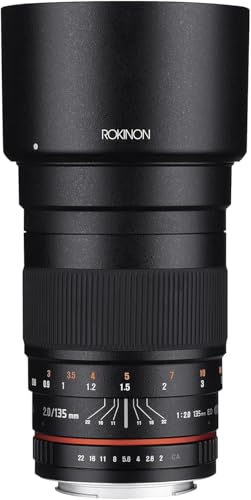
Rokinon 135mm f/2.0 Telephoto Lens
Best for: Canon DSLR portrait and video photography
- Lens Mount
- Canon
- Focal Length
- 135mm
- Maximum Aperture
- F2.0
- Sensor Format
- Full frame, APS-C
- Lens Type
- Telephoto
- Minimum Focus Distance
- 2.6 ft.
The Rokinon 135mm f/2.0 is a manual telephoto lens designed for Canon DSLR cameras. It features a fast f/2.0 maximum aperture and a fixed 135mm focal length, providing a narrow 12.4-degree angle of view on APS-C sensors. The lens includes nine diaphragm blades for smooth bokeh and weighs 1.8 pounds. It is suitable for photography and video work where a long reach and wide aperture are priorities.
- Fast f/2.0 maximum aperture for low light
- 9-blade diaphragm for circular bokeh
- ED element reduces chromatic aberration
- Compatible with full frame and APS-C sensors
- Fixed 135mm focal length limits versatility
- 1.8 pound weight is heavier than standard kit lenses
- Manual focus only with no autofocus motor
- You want a fast telephoto lens for portraits
- You shoot with Canon DSLR bodies
- You prefer manual focus control for video
- You need an autofocus lens for sports
- You require a zoom lens for variable framing
- You use Sony E-mount mirrorless cameras
Verdict: Rokinon 135mm f/2.0 Telephoto Lens is a solid option for Canon users seeking a bright, fixed focal length for portraits or video. It fits buyers who prioritize aperture speed over zoom flexibility and autofocus convenience.

OM System Olympus M.Zuiko 30mm F3.5 Macro
Best for: Macro photography on Micro Four Thirds cameras
- Focal Length
- 30mm
- Maximum Aperture
- f/3.5
- Sensor Format
- Micro Four Thirds
- Lens Type
- Macro
- Minimum Focus Distance
- 0.095 m
- Maximum Magnification
- 1.25x
This OM System lens is a compact macro option for Micro Four Thirds cameras. It offers 1.25x magnification, which is 2.5x in 35mm equivalent terms. The minimum focus distance is just 0.095 meters. You get a 40-degree angle of view and an aperture range from f/3.5 to f/22. It weighs 4.8 ounces and measures 2.2 inches in length. This lens suits you if you need close-up detail in a small package.
- 1.25x maximum magnification for detailed close-ups
- Minimum focus distance of 0.095 meters
- Compact weight of 4.8 ounces
- Aperture range from f/3.5 to f/22
- Maximum aperture of f/3.5 is slower than many standard prime lenses
- Fixed focal length of 30mm limits framing flexibility
- Heavier than some ultra-compact primes at 4.8 ounces
- You need high magnification for small subjects
- You shoot with Micro Four Thirds bodies
- You prefer a fixed focal length for composition
- You need a zoom lens for variable framing
- You require a wider angle of view than 40 degrees
- You want a faster aperture for low light
Verdict: OM System Olympus 30mm f/3.5 Macro Lens fits photographers who prioritize magnification and compact size over zoom versatility or wide apertures on Micro Four Thirds systems.

Sony 18-105mm F4 G OSS E-Mount Zoom
Best for: Versatile E-mount zoom photography
- Lens Mount
- E-mount
- Focal Length
- 18-105mm
- Maximum Aperture
- F4
- Lens Type
- Zoom
- Image Stabilization
- OSS
- Color
- Black
This Sony SELP18105G is a zoom lens for E-mount cameras. It offers a 27-158mm equivalent focal length with a constant F4 aperture. Two ED glass and three aspherical elements help maintain high resolution and contrast. The built-in OSS provides image stabilization. It weighs 15.1 ounces and measures 4.33 inches long. This lens suits photographers who need a versatile range for various shooting scenarios.
- Constant F4 maximum aperture across the entire zoom range
- Versatile 27-158mm equivalent focal length
- Includes two ED glass and three aspherical elements
- Built-in OSS image stabilization
- Heavier build at 15.1 ounces compared to many prime lenses
- Longer length of 4.33 inches may reduce portability
- Fixed F4 aperture limits low-light performance compared to wider options
- You need a single lens for varied focal lengths
- You shoot with Sony E-mount cameras
- You value image stabilization for handheld shots
- You require a wider maximum aperture for low light
- You prefer a compact prime lens for travel
- You use a camera mount other than E-mount
Verdict: Sony 18-105mm F4 G OSS E-Mount Lens provides a solid zoom range for E-mount users. It fits those who prioritize versatility and stabilization over extreme portability or wide apertures.

Sony 18-135mm OSS Zoom Lens
Best for: APS-C users wanting one versatile zoom
- Lens Mount
- Sony E
- Focal Length
- 18-135mm
- Maximum Aperture
- f/3.5-5.6
- Sensor Format
- APS-C
- Lens Type
- Zoom
- Image Stabilization
- Optical SteadyShot
This Sony zoom lens offers a 7.5x magnification range, covering 27-202.5mm in 35mm equivalent terms. It features Optical SteadyShot image stabilization to help you capture sharper stills and video. The lens uses aspherical and ED glass elements for sharpness and includes a 7-blade circular aperture for smooth bokeh. It is designed for APS-C sensor cameras and weighs 1.01 pounds.
- 7.5x high magnification zoom range
- Optical SteadyShot image stabilization
- 7-blade circular aperture for bokeh
- Sharp optics with ED glass elements
- Variable aperture slows to f/5.6 at the long end
- Heavier build at 1.01 pounds
- You want a single lens for varied shooting distances
- You shoot video and need optical stabilization
- You use an APS-C Sony E-mount camera
- You need a constant wide aperture for low light
- You prioritize the lightest possible gear
- You shoot with full-frame cameras
Verdict: Sony 18-135mm F3.5-5.6 OSS APS-C Lens provides a versatile 7.5x zoom range for APS-C users. It suits photographers who want one lens for both wide and telephoto shots without changing glass.

Canon 17-40mm f/4L EF Ultra Wide Angle Lens
Best for: Canon DSLR wide angle photography
- Focal Length
- 17-40mm
- Maximum Aperture
- f/4
- Lens Type
- Ultra Wide Angle
- Minimum Focus Distance
- 0.28m / 0.9 foot
- Color
- Black
- Dimensions
- 3.81 × 4.09 × 4.09 inches
This Canon lens is an ultra wide angle option with a 17-40mm focal length and a constant f/4 maximum aperture. It uses an inner focusing system with USM for quick operation. The closest focusing distance is 0.28m. It weighs 1.1 pounds and uses 77mm filters. You should consider it if you need wide coverage on Canon EF mount cameras.
- Constant f/4 maximum aperture across the zoom range
- Inner focusing system with USM for fast focusing
- Closest focusing distance of 0.28m / 0.9 foot
- Rotating type zoom system
- Fixed f/4 maximum aperture limits low light performance compared to f/2.8 or f/2.8L alternatives
- Heavier build at 1.1 pounds compared to lighter non-L series lenses
- You need a wide angle view for landscapes or architecture
- You shoot with Canon EF mount DSLR bodies
- You prefer a constant aperture for consistent exposure while zooming
- You use Sony E-mount or Micro Four Thirds cameras
- You require a faster aperture like f/2.8 for low light
- You need a telephoto reach beyond 40mm
Verdict: Canon 17-40mm f/4L Ultra Wide Angle Lens is a solid wide angle tool for Canon DSLR users who prioritize coverage over speed. It fits those who need reliable wide shots and do not mind the weight.

Canon EF 100mm f/2.8 Macro USM
Best for: Canon DSLR macro photography
- Lens Mount
- Canon EF
- Focal Length
- 100mm
- Maximum Aperture
- f/2.8
- Lens Type
- Macro
- Minimum Focus Distance
- 1 foot
- Color
- Black
This Canon EF 100mm f/2.8 Macro lens is designed for close-up photography on Canon SLR cameras. It features a 100mm focal length and a maximum aperture of f/2.8. The lens focuses as close as 1 foot to the subject. Its 3-group floating system helps maintain sharpness at close distances. This lens suits photographers who need detailed macro capabilities on Canon bodies.
- 100mm focal length for telephoto macro work
- f/2.8 maximum aperture for light gathering
- 1 foot minimum focus distance for close-ups
- Full-time manual focus capability
- 3-group floating system for close-up sharpness
- Fixed 100mm focal length limits versatility
- Canon EF mount is incompatible with Micro Four Thirds cameras
- Single focal length reduces zoom flexibility
- You shoot with Canon EF mount DSLR cameras
- You need a dedicated macro lens for close-up details
- You prefer a fixed focal length for consistent framing
- You use Micro Four Thirds cameras
- You need a zoom lens for variable framing
- You shoot with Sony or Nikon camera bodies
Verdict: Canon EF 100mm f/2.8 Macro Lens is a specialized tool for Canon DSLR users who require high-magnification close-up photography. It delivers sharp results at 1 foot distance but requires an EF mount camera to function.
Specifications side by side
| Spec | Panasonic 9mm F1.7 Ultra-Wide Lens | Rokinon 135mm f/2.0 Telephoto Lens | OM System Olympus M.Zuiko 30mm F3.5 Macro | Sony 18-105mm F4 G OSS E-Mount Zoom | Sony 18-135mm OSS Zoom Lens | Canon 17-40mm f/4L EF Ultra Wide Angle Lens | Canon EF 100mm f/2.8 Macro USM |
|---|---|---|---|---|---|---|---|
| Lens Mount | Micro Four Thirds | Canon | – | E-mount | Sony E | – | Canon EF |
| Focal Length | 9mm | 135mm | 30mm | 18-105mm | 18-135mm | 17-40mm | 100mm |
| Maximum Aperture | F1.7 | F2.0 | f/3.5 | F4 | f/3.5-5.6 | f/4 | f/2.8 |
| Sensor Format | Micro Four Thirds | Full frame, APS-C | Micro Four Thirds | – | APS-C | – | – |
| Lens Type | Ultra-wide | Telephoto | Macro | Zoom | Zoom | Ultra Wide Angle | Macro |
| Image Stabilization | – | – | – | OSS | Optical SteadyShot | – | – |
| Minimum Focus Distance | 0.095m | 2.6 ft. | 0.095 m | – | – | 0.28m / 0.9 foot | 1 foot |
| Maximum Magnification | 0.25x | – | 1.25x | – | – | – | – |
| Recommended Usage | – | Photography, Photography & Video | – | – | – | – | – |
| Color | Black | Black | Black | Black | Black | Black | Black |
| Sensor Size | – | – | – | – | APS-C Sensor | – | – |
| Intended Use | Video | Video | – | – | – | – | – |
| Dimensions | 2 × 2.4 × 2.4 inches | 3.2 × 4.09 × 4.09 inches | 2.2 × 2.2 × 2.4 inches | 4.33 × 3.07 × 3.07 inches | – | 3.81 × 4.09 × 4.09 inches | 2.99 × 2.13 × 2.13 inches |
| Weight | 7.36 ounces | 1.8 pounds | 4.8 ounces | 15.1 ounces | 1.01 pounds | 1.1 pounds | – |
| Length | – | – | – | – | 2.75 inches | – | – |
| Width | – | – | – | – | 3.5 inches | – | – |
| Size | 3.20 | 77mm | – | – | – | – | Lens Only |
| Model | H-X09 | 135M-C | V312040BU000 | SELP18105G | SEL18135 | 8806A007AA-cr | 4657A006-cr |
Frequently asked questions
Which lens is best for ultra-wide video work?
The Panasonic 9mm F1.7 Ultra-Wide Lens is the top choice for this task. It features a compact design measuring 2 inches in length and weighs 7.36 ounces. The lens is weather-sealed, making it suitable for outdoor video projects. Its fixed ultra-wide view allows for sharp images and smooth performance.
What is the best option for portrait photography?
The Rokinon 135mm f/2.0 Telephoto Lens is ideal for portraits. It provides a bright f/2.0 aperture that helps isolate subjects. The lens weighs 1.8 pounds and measures 3.2 inches in length. It is designed for Canon DSLR users who prioritize aperture speed over zoom flexibility.
Is there a budget-friendly macro lens available?
The OM System Olympus M.Zuiko 30mm F3.5 Macro is a strong budget option. It is designed for Micro Four Thirds cameras and focuses on magnification. The lens is compact, weighing only 4.8 ounces and measuring 2.2 inches in length. It fits users who need close-up capability without extra bulk.
Which lens offers the most versatility for E-mount cameras?
The Sony 18-105mm F4 G OSS Zoom Lens provides a solid range for E-mount users. It covers focal lengths up to 105mm with a constant f/4 maximum aperture. The lens weighs 15.1 ounces and measures 4.33 inches in length. It suits those who prioritize versatility and stabilization over extreme portability.
What is the best all-in-one zoom for APS-C sensors?
The Sony 18-135mm OSS Zoom Lens is built for APS-C users seeking one versatile lens. It offers a 7.5x zoom range, covering wide to telephoto shots. The lens weighs 1.01 pounds and measures 2.75 inches in length. It allows you to shoot without changing glass frequently.
Can I get a wide-angle lens for Canon DSLRs?
The Canon 17-40mm f/4L Ultra Wide Angle Lens is a solid choice. It provides reliable wide coverage for Canon DSLR users. The lens weighs 1.1 pounds and measures 3.81 inches in length. It is designed for those who prioritize coverage over speed and do not mind the additional weight.
Which lens is best for high-magnification close-ups on Canon?
The Canon EF 100mm f/2.8 Macro USM is specialized for close-up photography. It delivers sharp results at a 1-foot distance. The lens weighs approximately 1.1 pounds and measures 2.99 inches in length. It requires an EF mount camera to function properly.


