As Amazon Associates, we earn from qualifying purchases. This means we may receive a small commission at no extra cost to you if you click through and make a purchase.
As an Amazon Associate we earn from qualifying purchases. Links on this page are affiliate links.
When comparing a nikon vs rokinon camera lens, you face two distinct optical approaches. Both brands prioritize sharpness and edge-to-edge performance in their designs. The Nikon option is a versatile zoom lens with built-in autofocus, suitable for general photography. The Rokinon is a fixed focal length prime lens. It offers a wider maximum aperture for low-light work but requires manual focusing. You must choose between flexibility and speed.
Lens Type
Wide Angle Zoom
Telephoto Prime
Focal Length
24-70mm
135mm
Maximum Aperture
f/2.8
f/2.0
Autofocus
AF-S with Silent Wave Motor
Manual Focus
Weight
2.89 pounds
1.8 pounds
Lens Mount
Nikon
Canon (also available for other mounts)
Choose the first if
- You need a versatile focal range for events or portraits.
- You require fast and accurate autofocus for moving subjects.
- You shoot primarily with Nikon DSLR bodies.
Choose the second if
- You want a larger aperture for shallow depth of field.
- You prefer manual focus for controlled composition.
- You prioritize a lighter lens for travel or static shots.
Verdict
The Nikon lens suits photographers who need flexibility and speed in dynamic environments. The Rokinon lens is better for static subjects where maximum aperture and image quality are priorities. Your choice depends on whether you value zoom range or aperture speed.
Nikon vs Rokinon Lens Specs
Autofocus Technology
Edge: Nikon 24-70mm f/2.8G ED Lens
The Nikon 24-70mm f/2.8G ED features a built-in Silent Wave Motor for ultra-high-speed autofocus with exceptional accuracy and quiet operation. This makes it suitable for dynamic subjects where speed matters. The Rokinon 135mm f/2.0 is a manual focus lens with no internal motor listed. You must adjust focus by hand. If you need automatic focusing for moving subjects, the Nikon provides that capability directly. The Rokinon requires manual intervention for every shot. This is a clear functional difference for your shooting style.
Focal Length Versatility
Edge: Nikon 24-70mm f/2.8G ED Lens
The Nikon lens offers a 24-70mm zoom range, covering wide-angle to medium telephoto perspectives. This allows you to adjust your framing without changing lenses, making it versatile for various scenarios. The Rokinon is a fixed 135mm telephoto prime lens. It provides a narrow angle of view, ideal for portraits or distant subjects but limiting for general use. You cannot zoom with the Rokinon. The Nikon gives you multiple focal lengths in one body. This versatility is a significant advantage for general photography tasks.
Maximum Aperture
Edge: Rokinon 135mm f/2.0 Telephoto Lens
The Rokinon 135mm f/2.0 has a maximum aperture of f/2.0, which is wider than the Nikon's constant f/2.8. A wider aperture allows more light to reach the sensor, enabling better performance in low-light conditions. It also creates a shallower depth of field for background blur. The Nikon maintains f/2.8 across its zoom range. While still bright, it gathers less light than the Rokinon at its widest setting. For low-light shooting or strong bokeh, the Rokinon holds an advantage.
Weight and Portability
Edge: Rokinon 135mm f/2.0 Telephoto Lens
The Nikon lens weighs 2.89 pounds and measures 5.2 inches in length. The Rokinon lens weighs 1.8 pounds and is 3.2 inches long. The Rokinon is significantly lighter and more compact. This makes it easier to carry for extended periods or when using smaller camera bodies. The Nikon is heavier due to its complex zoom mechanism and autofocus motor. If you prioritize a lighter kit for travel or handheld shooting, the Rokinon is the more portable choice.
Sensor Format Compatibility
Edge: Tie
The Nikon lens is optimized for both Nikon FX (full frame) and DX (APS-C) format sensors. It covers both major Nikon sensor sizes effectively. The Rokinon lens is listed as compatible with full frame and APS-C cameras, specifically mentioning Canon mounts in the key specs but noting E mount compatibility in features. Both lenses support full frame sensors. The Nikon explicitly states optimization for edge-to-edge sharpness on FX sensors. The Rokinon also supports full frame. Both are suitable for full frame users, though the Nikon specifies its optimization clearly.
Which lens fits your shooting style
Event photographers needing speed and reach
Our pick: Nikon 24-70mm f/2.8G ED Lens
You need a zoom range that covers wide angles to medium telephoto. This Nikon lens offers 24-70mm focal length with a constant f/2.8 maximum aperture. The built-in Silent Wave Motor ensures fast, accurate autofocus. It is optimized for both FX and DX sensors, making it versatile for various shooting scenarios without changing lenses.
Portrait shooters wanting shallow depth of field
Our pick: Rokinon 135mm f/2.0 Telephoto Lens
You require a dedicated telephoto prime for tight portraits. This Rokinon lens provides a 135mm focal length with a wide f/2.0 maximum aperture. This wide aperture allows for significant background blur. The fixed focal length encourages you to move for composition, while the ED element helps reduce chromatic aberration for cleaner images.
Video creators on Canon DSLR systems
Our pick: Rokinon 135mm f/2.0 Telephoto Lens
You shoot video on Canon cameras and need a lightweight prime. This Rokinon lens is compatible with Canon DSLRs and includes a removable lens hood. Its 135mm focal length is ideal for framing subjects. The manual focus design gives you full control over focus transitions, which is often preferred for cinematic video work.

Nikon 24-70mm f/2.8G ED Lens
Best for: Nikon FX and DX users needing f/2.8 versatility
- Focal Length
- 24-70mm
- Maximum Aperture
- f/2.8
- Sensor Format
- Nikon FX, DX
- Lens Type
- Wide Angle Zoom
- Dimensions
- 5.2 × 3.3 × 3.3 inches
- Weight
- 2.89 pounds
This Nikon 24-70mm f/2.8G ED lens is a wide-angle zoom designed for FX and DX sensor formats. It features a constant maximum aperture of f/2.8 across its focal range. The build includes two ED elements and PGM aspherical lenses to control chromatic aberration. Weighing 2.89 pounds, it offers fast autofocus via a Silent Wave Motor. This lens suits photographers needing sharp edge-to-edge performance in varied lighting.
- Constant f/2.8 maximum aperture for low-light shooting
- Silent Wave Motor enables quiet, high-speed autofocus
- Nano Crystal Coat reduces ghosting and flare
- Optimized for both FX and DX sensor formats
- Heavier at 2.89 pounds compared to lighter alternatives
- Larger physical dimensions at 5.2 inches in length
- Shorter 90-day warranty than standard new product coverage
- You shoot in variable light and need a wide aperture
- You use Nikon FX or DX bodies and want versatility
- You prioritize autofocus speed and silence during use
- You need a longer telephoto reach than 70mm
- You prefer ultra-lightweight gear for travel
- You want a prime lens for maximum sharpness
Verdict: Nikon 24-70mm f/2.8G ED Lens is a robust zoom for Nikon shooters who value consistent light gathering and fast focusing. It fits professionals who need reliable performance across wide to medium telephoto ranges.
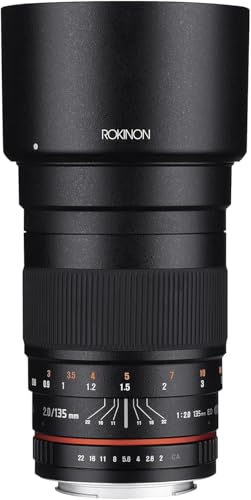
Rokinon 135mm f/2.0 Telephoto Lens
Best for: Canon DSLR portrait and video work
- Lens Mount
- Canon
- Focal Length
- 135mm
- Maximum Aperture
- F2.0
- Sensor Format
- Full frame, APS-C
- Lens Type
- Telephoto
- Minimum Focus Distance
- 2.6 ft.
The Rokinon 135mm f/2.0 is a manual telephoto lens designed for Canon DSLR bodies. It features a fast f/2.0 maximum aperture and an extra-low dispersion element to reduce chromatic aberration. The lens weighs 1.8 pounds and measures 3.2 inches in length. It supports full-frame sensors with an 18.8-degree angle of view. You will appreciate this optic for portrait work or video projects requiring shallow depth of field.
- Fast f/2.0 maximum aperture for low light
- Extra-low dispersion element reduces chromatic aberration
- 9-blade diaphragm for smoother bokeh
- Full frame compatible with 18.8-degree angle of view
- Heavier build at 1.8 pounds compared to lighter alternatives
- Longer physical length of 3.2 inches
- Manual focus only with no autofocus motor
- You shoot portraits and need a fast aperture
- You use Canon DSLRs and prefer manual control
- You want a dedicated telephoto prime for video
- You require autofocus for fast-moving subjects
- You shoot with Sony E-mount mirrorless cameras
- You need a zoom lens for variable framing
Verdict: The Rokinon 135mm f/2.0 Telephoto Lens suits Canon users who prioritize optical quality and aperture speed over autofocus convenience. It delivers sharp images with minimal aberration for static subjects.
Specifications side by side
| Spec | Nikon 24-70mm f/2.8G ED Lens | Rokinon 135mm f/2.0 Telephoto Lens |
|---|---|---|
| Lens Mount | – | Canon |
| Focal Length | 24-70mm | 135mm |
| Maximum Aperture | f/2.8 | F2.0 |
| Sensor Format | Nikon FX, DX | Full frame, APS-C |
| Lens Type | Wide Angle Zoom | Telephoto |
| Minimum Focus Distance | – | 2.6 ft. |
| Recommended Usage | – | Photography, Photography & Video |
| Color | – | Black |
| Intended Use | – | Video |
| Dimensions | 5.2 × 3.3 × 3.3 inches | 3.2 × 4.09 × 4.09 inches |
| Weight | 2.89 pounds | 1.8 pounds |
| Model | CRTNK2470GRB | 135M-C |
| Size | – | 77mm |
Frequently asked questions
Which lens is better for Nikon camera users?
The Nikon 24-70mm f/2.8G ED Lens is designed specifically for Nikon FX and DX users. It provides a versatile 24-70mm focal length with a constant f/2.8 aperture. This lens includes built-in autofocus, making it suitable for dynamic shooting scenarios where speed and reliability are essential.
Is the Rokinon lens compatible with Canon cameras?
Yes, the Rokinon 135mm f/2.0 Telephoto Lens is intended for Canon DSLR users. It is optimized for portrait and video work on Canon bodies. The lens model 135M-C is built for manual focus, prioritizing optical quality and aperture speed over automatic focusing convenience.
What is the weight difference between these two lenses?
The Nikon 24-70mm f/2.8G ED Lens weighs 2.89 pounds. The Rokinon 135mm f/2.0 Telephoto Lens weighs 1.8 pounds. The Rokinon option is significantly lighter, which may benefit users carrying equipment for extended periods or those prioritizing portability in their kit.
Does the Nikon lens have autofocus?
Yes, the Nikon 24-70mm f/2.8G ED Lens features a built-in Silent Wave Motor. This provides ultra-high-speed autofocus with exceptional accuracy and quiet operation. It is ideal for capturing moving subjects without the noise associated with other autofocus mechanisms.
What focal length does the Nikon lens offer?
The Nikon 24-70mm f/2.8G ED Lens offers a wide-angle zoom range of 24-70mm. This covers wide angles to medium telephoto perspectives. It is a robust zoom suitable for professionals needing reliable performance across various shooting distances and compositions.
Is the Rokinon lens good for video?
The Rokinon 135mm f/2.0 Telephoto Lens is recommended for photography and video use. Its fixed focal length and f/2.0 aperture allow for sharp images with minimal aberration. It suits static subjects and portrait work where manual focus control is preferred.
Which lens is larger in physical size?
The Nikon 24-70mm f/2.8G ED Lens measures 5.2 inches in length and 3.3 inches in width and height. The Rokinon 135mm f/2.0 Telephoto Lens is 3.2 inches long with a 4.09-inch width and height. The Nikon lens is longer, while the Rokinon is wider.


