As Amazon Associates, we earn from qualifying purchases. This means we may receive a small commission at no extra cost to you if you click through and make a purchase.
As an Amazon Associate we earn from qualifying purchases. Links on this page are affiliate links.
This mirrorless camera buying guide helps you choose the right system for your needs. You will learn how to weigh sensor size, resolution, and video capabilities against your budget and shooting style. We compared 8 models strictly by their published specifications to ensure an objective selection process. Each product was evaluated on technical merits like autofocus speed, burst rates, and physical dimensions.
After reading, you will be able to decide between full-frame and APS-C sensors based on your priority for image quality or portability. You will understand how lens kits affect value and which bodies suit specific tasks like vlogging or sports. The guide walks through key decisions regarding video resolution, weight, and intended use. You can confidently select a camera that matches your technical requirements without relying on subjective opinions or marketing claims.
Key Specs to Check First
Sensor format and size
The sensor format determines image quality, low-light performance, and depth of field. Full-frame sensors, like those in the Canon EOS R6 Mark II and Sony A7 IV, capture more light and offer superior dynamic range. APS-C sensors, found in the Canon R50, R100, and Sony a6400, provide a good balance of quality and compact size. You should choose full-frame if you prioritize maximum image fidelity and professional video capabilities. Choose APS-C if you need a lighter, more portable system for travel or casual shooting. The trade-off is cost and body size versus image performance.
Look for
- Full-Frame or APS-C designation
- Sensor size relative to body
- Low-light performance claims
Video resolution and frame rate
Video resolution defines the clarity of your footage. Most modern mirrorless cameras, including the Sony A7 IV and Canon EOS M50, offer 4K video options. Higher resolutions like 4K 60p, available on the Sony A7 IV, provide smoother motion and better cropping flexibility. If you only need 1080p, entry-level models like the Canon EOS R100 suffice. You should match the video spec to your output needs. Professional YouTube or cinematic work benefits from 4K oversampling. Casual sharing may not require high frame rates. Check if the camera records 4K without heavy cropping to maintain your lens's field of view.
Look for
- 4K video support
- Maximum frame rate (fps)
- Cropping factor in 4K mode
Autofocus technology
Autofocus speed and accuracy are critical for capturing sharp images, especially in action or video. The Canon EOS R6 Mark II features advanced subject detection for reliable tracking. The Canon EOS R50 utilizes Dual Pixel AF for fast and accurate focusing on eyes and faces. Older models like the Sony a6000 have competent autofocus but may lag behind newer technology in subject recognition. You should look for cameras with reliable eye-tracking for portraits and continuous tracking for moving subjects. Dual Pixel AF is a strong indicator of smooth video focusing. Consider your shooting style; fast action requires superior AF systems.
Look for
- Dual Pixel AF or equivalent
- Eye-tracking capability
- Subject detection features
Included lens and configuration
Configuration determines whether you buy a body only or a kit with a lens. Kits like the Canon EOS R50 with 18-45mm Lens or the Sony Alpha a6000 with 16-50mm Lens offer immediate usability. Body-only options, such as the Canon EOS R6 Mark II, allow you to select specific glass later. The included lens usually covers a standard zoom range, suitable for general photography. You should decide if you need an immediate all-in-one solution or the flexibility to invest in specialized lenses later. Kits are convenient for beginners. Body-only setups suit those with existing lenses or specific focal length needs.
Look for
- Body only or kit
- Included lens focal range
- Lens aperture specifications
Recommended usage and features
Cameras are often tailored for specific tasks. The Canon EOS R50 is recommended for vlogging, featuring a flexible screen and easy wireless sharing. The Sony a6400 includes a touchscreen and is noted for portable video and action. The Canon EOS M50 is highlighted for compact 4K video and travel. You should align the camera's intended use with your primary activity. Vloggers need flip screens and audio inputs. Action photographers need high burst rates. Travelers need compact bodies. Check the recommended usage to ensure the feature set matches your workflow, such as touchscreen availability for intuitive control.
Look for
- Intended use designation
- Touchscreen or flip screen
- Wireless sharing capabilities
Sensor resolution and image quality
Sensor resolution, measured in megapixels, impacts the level of detail in your photos. The Sony A7 IV offers 33MP, providing high-resolution images suitable for large prints or heavy cropping. The Canon EOS R50 has 24.2MP, which is sufficient for most digital uses. The Sony Alpha a6000 provides 24.3MP for everyday photography. Higher megapixels do not always mean better images; they also increase file sizes and processing demands. You should choose based on your output needs. Web and social media do not require extreme resolution. Professional prints or commercial work benefit from higher counts. Balance resolution with other specs like dynamic range.
Look for
- Megapixel count
- File size implications
- Crop flexibility potential
Types of Mirrorless Cameras
Full-frame hybrids
Full-frame models like the Canon EOS R6 Mark II and Sony A7 IV prioritize image quality and low-light performance. These cameras feature larger sensors that capture more light, resulting in superior dynamic range and cleaner high-ISO images. The Canon R6 Mark II offers fast autofocus and high-speed bursts, ideal for action. The Sony A7 IV provides 33MP resolution and 4K 60p video for professional work. You trade portability for this enhanced performance. These bodies are heavier, weighing around 2.7 to 2.8 pounds, making them less suitable for all-day travel but excellent for studio or event photography.
APS-C vlogging kits
APS-C cameras like the Canon EOS R50 and R100 balance performance with portability. They are designed for content creators who need 4K video and reliable autofocus in a compact body. The R50 includes Dual Pixel AF and a flexible screen, while the R100 offers a lightweight all-in-one kit. These models are smaller and lighter, often under 2 pounds, making them easy to carry for vlogging or casual shooting. You gain ease of use and portability but sacrifice the shallow depth of field and extreme low-light capability of full-frame sensors. They are ideal for beginners and travel photographers.
Compact entry-level
Entry-level mirrorless cameras like the Sony Alpha a6000 and Canon EOS M50 focus on speed and size. The a6000 delivers strong autofocus and 24.3MP resolution in a small package, weighing just 1.68 pounds. The M50 offers 4K video and a compact form factor for travel. These cameras are lightweight and affordable, fitting easily into a bag. You get reliable everyday performance and quick burst shooting. The trade-off is usually smaller screens, fewer advanced video features, and slower continuous shooting speeds compared to higher-end models. They suit beginners who want to learn photography without carrying heavy gear.
Common mistakes to avoid
Ignoring lens ecosystem compatibility
Buying a camera body without checking available lenses limits your system. Mirrorless mounts vary significantly between brands. Ensure your chosen mount has the focal lengths and apertures you need. Check for native lenses that match your shooting style before committing to a specific camera body.
Overlooking autofocus system type
Not all autofocus systems perform equally in different scenarios. Some rely on contrast detection, which can be slow. Others use phase detection with dedicated sensors. Check if the camera features eye-tracking for people or animals. This matters for portraits and wildlife. Match the AF type to your primary subject.
Assuming all sensors are equal
Sensor size directly impacts image quality and low-light performance. Full-frame sensors generally handle high ISO better than APS-C or Micro Four Thirds. Larger sensors also offer shallower depth of field. Consider your shooting environment. If you shoot in low light often, prioritize a larger sensor format over resolution alone.
Neglecting video specifications
Many buyers focus only on photos but forget video needs. Check maximum resolution, frame rates, and codec support. Some cameras record 4K but lack internal recording or have rolling shutter issues. If you plan to shoot video, verify the specs for stabilization and audio inputs. Ensure the camera meets your video workflow.
| # | Product | Best for | Price |
|---|---|---|---|
| 1 | Canon EOS R6 Mark II Full-Frame | fast action and full-frame quality | |
| 2 | Canon EOS R50 with 18-45mm Lens | portable vlogging and casual photography | |
| 3 | Canon EOS R100 with 18-45mm Lens Bundle | beginners seeking a lightweight, all-in-one camera kit | |
| 4 | Sony A7 IV Full-Frame Hybrid Camera | Full-frame photography and high-end video work | |
| 5 | Sony Alpha a6000 24.3MP APS-C Camera | beginners seeking portability and speed | |
| 6 | Canon EOS R50 24.2MP APS-C Mirrorless Camera | vlogging and content creation | |
| 7 | Canon EOS M50 with 15-45mm Lens | compact 4K video and travel photography | |
| 8 | Sony Alpha a6400 APS-C Camera | portable video and action photography |

Canon EOS R6 Mark II Full-Frame
Best for: fast action and full-frame quality
- Sensor Format
- Full-frame
- Sensor Resolution
- 24.2 megapixel
- Continuous Shooting Speed
- Up to 12 fps mech / 40 fps elec
- Image Processor
- DIGIC X
- Configuration
- Body Only
- Color
- Black
The Canon EOS R6 Mark II is a full-frame mirrorless camera featuring a 24.2-megapixel CMOS sensor and DIGIC X processor. It offers high-speed continuous shooting up to 40 fps with an electronic shutter. The Dual Pixel CMOS AF II covers 100% of the frame with 1,053 zones. This body-only model weighs 2.8 pounds. It suits photographers who need fast autofocus and high-resolution full-frame imagery.
- 24.2-megapixel full-frame CMOS sensor for high image quality
- Up to 40 fps continuous shooting with electronic shutter
- Dual Pixel CMOS AF II with 1,053 AF zones
- ISO range of 100-102400, expandable to 204800
- Heavier build at 2.8 pounds compared to lighter APS-C competitors
- Lower resolution at 24.2 megapixels versus higher-count full-frame options
- Body-only configuration requires separate lens purchase
- You need fast autofocus coverage across the entire frame
- You shoot action or sports requiring high burst rates
- You prefer full-frame sensor image quality
- You want a kit with a lens included
- You prioritize ultra-high resolution over speed
- You need a lightweight travel camera under 2 pounds
Verdict: The Canon EOS R6 Mark II Full-frame fits photographers who prioritize fast autofocus and high-speed shooting in a full-frame body. It is ideal for action and sports shooters who need reliable subject detection and burst capabilities.

Canon EOS R50 with 18-45mm Lens
Best for: portable vlogging and casual photography
- Sensor Format
- APS-C
- Sensor Resolution
- 24.2 Megapixel
- Max Video Resolution
- 4K
- Continuous Shooting Speed
- 12 fps, 15 fps
- Lens Mount
- RF mount
- Configuration
- w/RF-S18-45mm F4.5-6.3 is STM Lens
The Canon EOS R50 is a compact mirrorless camera with a 24.2-megapixel APS-C sensor and DIGIC X processor. It records 4K video at 30 fps and shoots stills at up to 15 fps. The lens mount is RF, and it includes an 18-45mm lens. This model suits vloggers and casual shooters who need a lightweight body with reliable autofocus for people and animals.
- 24.2 MP APS-C CMOS sensor
- 4K uncropped video at 30 fps
- 15 fps continuous shooting with electronic shutter
- Dual Pixel CMOS AF II with subject tracking
- 4K video limited to 30 fps, lower than some competitors
- 18-45mm lens has a variable maximum aperture of f/4.5-6.3
- Includes a kit lens rather than a professional prime
- You want a lightweight camera for travel vlogging
- You need reliable autofocus for moving subjects
- You prefer a compact body with a kit lens
- You require full-frame sensor resolution
- You need 4K video at 60 fps or higher
- You want a camera with a fixed high-aperture lens
Verdict: The Canon R50 APS-C Vlogging Camera delivers solid 4K video and fast autofocus in a small package. It fits beginners and vloggers who prioritize portability and ease of use over high-end video frame rates.

Canon EOS R100 with 18-45mm Lens Bundle
Best for: beginners seeking a lightweight, all-in-one camera kit
- Sensor Format
- APS-C
- Sensor Resolution
- 24.2 MP
- Max Video Resolution
- 4K
- Continuous Shooting Speed
- 6.5 fps
- Configuration
- Kit with 18-45mm Lens
- Image Processor
- DIGIC 8
The Canon EOS R100 is an APS-C mirrorless camera featuring a 24.2MP sensor and DIGIC 8 processor. It records 4K video at 24p and captures stills at 6.5 fps. The kit includes an 18-45mm lens, a 64GB SD card, and various accessories. This setup suits beginners who want a compact, lightweight system for everyday shooting and basic video work.
- 24.2MP APS-C CMOS sensor for detailed images
- Compact dimensions at 3.5 x 3.3 x 4.8 inches
- Lightweight build at 1 pound for easy carrying
- Includes 64GB SD card and wide/telephoto attachments
- 4K video limited to 24p with a crop factor
- Continuous shooting speed of 6.5 fps is modest
- LCD resolution is 1.04m dots, lower than many peers
- You want a lightweight, entry-level mirrorless system
- You need a complete kit with lenses and memory
- You prioritize portability over high-speed action shooting
- You require 4K video at 30p or higher frame rates
- You need fast continuous shooting for sports or wildlife
- You prefer a high-resolution LCD screen for precise framing
Verdict: The Canon EOS R100 APS-C Kit is a solid starting point for beginners who value portability and a complete accessory package over advanced video or speed features.

Sony A7 IV Full-Frame Hybrid Camera
Best for: Full-frame photography and high-end video work
- Sensor Format
- Full-frame
- Sensor Resolution
- 33MP
- Max Video Resolution
- 4K
- Image Processor
- BIONZ XR
- Color
- Black
- Dimensions
- 3.1 × 5.2 × 3.8 inches
This renewed Sony Alpha 7 IV is a full-frame mirrorless camera featuring a 33MP Exmor R sensor and BIONZ XR processor. It records 4K video at up to 60p with 10-bit color depth. The body measures 5.2 by 3.8 by 3.1 inches and weighs 2.7 pounds. It suits photographers who need high resolution and robust video capabilities in a professional-grade format.
- 33MP full-frame Exmor R back-illuminated CMOS sensor
- Records 4K 60p 10-bit 4:2:2 video
- 7K oversampling for 4K 30p with no pixel binning
- Includes S-Cinetone color profile for natural colors
- Weighs 2.7 pounds, which is heavier than the APS-C models on this list
- Full-frame body is bulkier than the compact options like the a6000 or R50
- Sold as a renewed unit rather than new
- You need a full-frame sensor for better low-light performance
- You require high-resolution 33MP stills
- You want 4K 60p video with 10-bit color depth
- You prefer a lighter, more compact camera for travel
- You want a new condition product without renewed status
- You are on a budget and need a lower-cost entry-level model
Verdict: Sony A7 IV Full-Frame 33MP is a high-specification full-frame camera that fits professionals needing 4K 60p video and 33MP resolution. It is a solid choice for those who prioritize image quality over portability.

Sony Alpha a6000 24.3MP APS-C Camera
Best for: beginners seeking portability and speed
- Sensor Format
- APS-C
- Sensor Resolution
- 24 MP
- Continuous Shooting Speed
- Up to 11 FPS
- Lens Mount
- Sony E-mount
- Configuration
- w/ 16-50mm Power Zoom Lens
- Color
- Black
The Sony Alpha a6000 is a compact mirrorless camera featuring a 24.3 MP APS-C CMOS sensor. It offers a focus sensitivity range of EV 0 to EV 20 and hybrid autofocus with 179 phase-detection points. The camera shoots up to 11 FPS and supports ISO settings from 100 to 25600. You will appreciate its lightweight build at 1.68 pounds. This model suits beginners seeking reliable image quality and fast burst shooting in a portable body.
- 24.3 MP APS-C CMOS sensor delivers detailed images.
- 179-point hybrid autofocus system ensures sharp focus.
- Up to 11 FPS continuous shooting for action.
- ISO 100-25600 range handles various lighting conditions.
- 11 FPS burst speed is lower than the 12 FPS capability of the Sony a6400.
- APS-C sensor size is smaller than the full-frame sensor in the Sony Alpha 7 IV.
- 1.68 pound weight is heavier than the 1.06 pound Sony Alpha a6400.
- You want a lightweight camera for travel.
- You need fast autofocus for sports or wildlife.
- You are starting with Sony E-mount lenses.
- You require full-frame image quality.
- You need 4K video recording capabilities.
- You prefer a camera under 1.5 pounds.
Verdict: The Sony Alpha a6000 APS-C Mirrorless Camera fits beginners who value portability and speed. It delivers strong autofocus and high-resolution images for everyday photography.
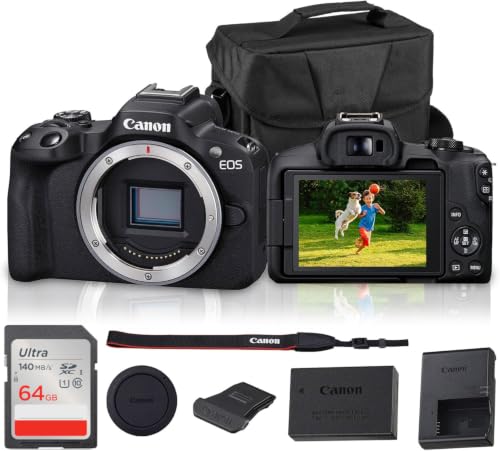
Canon EOS R50 24.2MP APS-C Mirrorless Camera
Best for: vlogging and content creation
- Sensor Format
- APS-C
- Sensor Resolution
- 24.2MP
- Max Video Resolution
- 4K
- Continuous Shooting Speed
- 15 fps
- Lens Mount
- RF and RF-S
- Recommended Usage
- Vlogging
The Canon EOS R50 is an APS-C mirrorless camera designed for vlogging and content creation. It features a 24.2MP sensor and records 4K 30p video oversampled from 6K. You get 15fps burst shooting with Dual Pixel AF II for tracking people, pets, and vehicles. The fully articulating vari-angle touchscreen aids framing. It includes built-in stereo mics and Wi-Fi and Bluetooth connectivity for sharing images.
- 24.2MP APS-C sensor
- 4K 30p video recording
- 15fps continuous shooting
- Fully articulating vari-angle touchscreen
- Dual Pixel AF II tracking
- 15fps burst speed is lower than the 20fps found on the Sony a6400
- APS-C sensor is smaller than the full-frame sensor in the Sony Alpha 7 IV
- 2-pound weight is heavier than the 0.85-pound Sony a6000
- You need a camera with a vari-angle screen for vlogging
- You want reliable subject tracking for people or pets
- You prefer Canon's RF lens ecosystem
- You require full-frame image quality
- You need high-speed burst shooting above 15fps
- You prioritize the lightest possible camera body
Verdict: Canon EOS R50 APS-C Mirrorless Camera suits vloggers who need a flexible screen and solid autofocus. It fits creators who value 4K video oversampling and easy wireless sharing over raw speed or full-frame sensors.

Canon EOS M50 with 15-45mm Lens
Best for: compact 4K video and travel photography
- Sensor Format
- APS-C
- Sensor Resolution
- 24.1 Megapixel
- Max Video Resolution
- 4K UHD
- Configuration
- Kit w/EF-M15-45mm
- Included Lens
- 15-45mm Lens
- Color
- Black
The Canon EOS M50 is a compact mirrorless camera with a 24.1-megapixel APS-C sensor. It captures 4K UHD video at 24p and HD slow motion at 120p. The kit includes an EF-M 15-45mm lens. It weighs 13.7 ounces and measures 4.6 by 3.5 by 2.3 inches. This model suits you if you want a lightweight body with decent resolution and 4K recording capability for video projects.
- 24.1 Megapixel APS-C CMOS sensor
- 4K UHD 24p video recording
- HD 120p slow motion capability
- Built-in OLED EVF with touch control
- Max video frame rate of 24p in 4K is lower than the 30p found on the Sony a6400 and Canon R50
- Sensor resolution of 24.1MP is slightly lower than the 24.2MP on the Canon R50 and 24.3MP on the Sony a6000
- You need a lightweight camera under 14 ounces for travel
- You want 4K video recording in a compact body
- You prefer an optical viewfinder for framing shots
- You require 4K video at 30p or higher frame rates
- You need a full-frame sensor for shallow depth of field
- You want the latest Dual Pixel AF with eye detection as found on newer models
Verdict: The Canon EOS M50 APS-C 24.1MP is a solid entry-level choice for creators who prioritize portability and 4K video over the highest resolution or fastest frame rates. It fits users who need a small, lightweight mirrorless system for everyday shooting.

Sony Alpha a6400 APS-C Camera
Best for: portable video and action photography
- Sensor Format
- APS-C
- Max Video Resolution
- 4K
- Continuous Shooting Speed
- 11Fps
- Configuration
- Body
- Color
- Black
- Sensor Size
- APS-C Sensor
The Sony a6400 is a compact APS-C mirrorless camera designed for stills and video. It features a 24.2MP sensor and shoots 4K video. The autofocus covers 84% of the sensor with 425 phase detection points. You get continuous shooting at 11 fps. The tiltable touchscreen display supports vlogging and flexible framing. It weighs 1.41 pounds, making it portable for daily carry.
- 24.2MP APS-C sensor for detailed images
- 4K video resolution for high-quality footage
- 11 fps continuous shooting speed
- 425 phase detection points for fast autofocus
- Tiltable touchscreen LCD for flexible angles
- 1.41 pound weight is heavier than the Sony a6000
- 4K video is limited to 30 fps, unlike the 60 fps on the Canon R50
- APS-C sensor is smaller than the full-frame sensor in the Sony Alpha 7 IV
- You want fast autofocus for tracking moving subjects
- You need a compact body for travel
- You shoot video and stills in the same sessions
- You require full-frame image quality
- You need 4K video at 60 fps
- You prefer a camera lighter than 1.41 pounds
Verdict: The Sony a6400 Compact APS-C Mirrorless Camera fits photographers who prioritize speed and portability. You get reliable autofocus and 4K video in a body that balances performance with size.
Specifications side by side
| Spec | Canon EOS R6 Mark II Full-Frame | Canon EOS R50 with 18-45mm Lens | Canon EOS R100 with 18-45mm Lens Bundle | Sony A7 IV Full-Frame Hybrid Camera | Sony Alpha a6000 24.3MP APS-C Camera | Canon EOS R50 24.2MP APS-C Mirrorless Camera | Canon EOS M50 with 15-45mm Lens | Sony Alpha a6400 APS-C Camera |
|---|---|---|---|---|---|---|---|---|
| Sensor Format | Full-frame | APS-C | APS-C | Full-frame | APS-C | APS-C | APS-C | APS-C |
| Sensor Resolution | 24.2 megapixel | 24.2 Megapixel | 24.2 MP | 33MP | 24 MP | 24.2MP | 24.1 Megapixel | – |
| Max Video Resolution | – | 4K | 4K | 4K | – | 4K | 4K UHD | 4K |
| Continuous Shooting Speed | Up to 12 fps mech / 40 fps elec | 12 fps, 15 fps | 6.5 fps | – | Up to 11 FPS | 15 fps | – | 11Fps |
| Lens Mount | – | RF mount | – | – | Sony E-mount | RF and RF-S | – | – |
| Configuration | – | w/RF-S18-45mm F4.5-6.3 is STM Lens | Kit with 18-45mm Lens | – | w/ 16-50mm Power Zoom Lens | – | Kit w/EF-M15-45mm | Body |
| Image Processor | DIGIC X | DIGIC X | DIGIC 8 | BIONZ XR | – | – | – | – |
| Video Resolution | – | – | – | – | – | 4K | 4K | 4K |
| Recommended Usage | – | Vlogging | – | – | – | Vlogging | – | – |
| Included Lens | – | 18-45mm Lens | 18-45mm Lens | – | 16-50mm Lens | – | 15-45mm Lens | – |
| Autofocus Technology | – | – | – | – | – | Dual Pixel AF | – | – |
| Color | Black | Black | Black | Black | Black | Black | Black | Black |
| Sensor Size | – | – | – | – | – | APS-C Sensor | – | APS-C Sensor |
| Display Feature | – | – | – | – | – | – | – | Touch Screen |
| Focal Length | – | – | – | – | 50mm | – | – | – |
| Maximum Aperture | – | f/4 | f/4 | – | – | – | – | – |
| Intended Use | – | – | – | – | – | Video | Video | Video |
| Features | – | – | – | – | – | – | – | Touchscreen |
| Dimensions | 4 × 6 × 4 inches | 3 × 5 × 4 inches | 4.8 × 3.5 × 3.3 inches | 3.1 × 5.2 × 3.8 inches | 6.25 × 5 × 5 inches | 8 × 7 × 6 inches | 2.3 × 4.6 × 3.5 inches | 6.1 × 5.6 × 4.5 inches |
| Weight | 2.8 pounds | 1 pounds | 1 pounds | 2.7 pounds | 1.68 pounds | 2 pounds | 13.7 ounces | 1.41 pounds |
| Model | R6 Mark II | R50 | Canon EOS R100 | A7 IV | ILCE6000L/B-cr | 5811C002_EDIP_1 | 2680C011 | ILCE6400/B |
| Size | – | – | – | – | 45.1mm x 120mm x 66.9mm | – | – | ILCE6400/B |
You can reference the mirrorless camera buying guide to compare sensor specifications and autofocus features across selected models.
Frequently asked questions
Which mirrorless camera is best for fast action?
The Canon EOS R6 Mark II is the top choice for fast action. It features a full-frame sensor and is designed for photographers who need reliable subject detection and high-speed burst capabilities. This model fits sports shooters who prioritize speed and autofocus performance over other factors.
What is the lightest mirrorless camera on the list?
The Canon EOS R100 with 18-45mm Lens Bundle is the lightest option at 1 pound. It measures 3.5 inches wide and 4.8 inches long. This kit is ideal for beginners seeking a lightweight, all-in-one camera package. You get portability and a complete accessory set in a small body.
Which camera offers the highest resolution?
The Sony A7 IV Full-Frame Hybrid Camera offers 33MP resolution. It is designed for professionals needing high image quality and 4K 60p video. This full-frame model prioritizes resolution and video capabilities over portability. You get a robust body for serious photography and hybrid work.
Are there mirrorless cameras with touch screens?
Yes, the Sony Alpha a6400 APS-C Camera includes a touch screen. This feature supports intuitive control for both photography and video. The a6400 also delivers 4K video and reliable autofocus in a compact APS-C body. It balances performance with size for portable shooting.
Which camera is best for vlogging?
The Canon EOS R50 with 18-45mm Lens is best for portable vlogging. It delivers solid 4K video and fast autofocus in a small package. The camera fits beginners who prioritize ease of use. You get a flexible screen and wireless sharing features for content creation.
What is the largest mirrorless camera by weight?
The Canon EOS R6 Mark II Full-Frame is the heaviest at 2.8 pounds. It measures 6 inches wide and 4 inches high. This full-frame body is built for durability and performance. You get a substantial camera designed for fast action and high-quality image capture.


