As Amazon Associates, we earn from qualifying purchases. This means we may receive a small commission at no extra cost to you if you click through and make a purchase.
As an Amazon Associate we earn from qualifying purchases. Links on this page are affiliate links.
This guide compares the Canon EF 16-35mm f/2.8L II USM against the Rokinon 135mm f/2.0 Telephoto Lens. We examine the canon vs rokinon camera lens options to help you decide. Both are black lenses for Canon cameras. The main difference is their focal length and purpose. The Canon is an ultra-wide-angle zoom. The Rokinon is a fixed telephoto prime. Understanding these specs helps you pick the right tool.
Lens Type
Ultra-wide-angle zoom
Telephoto prime
Focal Length
16-35mm
135mm
Maximum Aperture
f/2.8
f/2.0
Minimum Focus Distance
0.92 feet
2.6 ft.
Weight
2.15 pounds
1.8 pounds
Choose the first if
- You need a wide field of view for landscapes or architecture.
- You require autofocus for fast-moving subjects.
- You want a versatile zoom range for varied compositions.
Choose the second if
- You want a shallower depth of field for portraits.
- You prefer a lighter lens for travel.
- You need a longer reach for distant subjects.
Verdict
Choose the Canon if you need a versatile wide-angle zoom with autofocus. Pick the Rokinon if you want a lightweight telephoto prime with a wider maximum aperture. Your choice depends on whether you prioritize focal length flexibility or aperture speed.
Canon vs Rokinon Lens Specs
Focal Length
Edge: Tie
The Canon EF 16-35mm f/2.8L II USM is an ultra-wide-angle zoom lens. Its focal length ranges from 16mm to 35mm. This range is ideal for landscapes, architecture, and tight indoor spaces. You get a variable perspective that adapts to your composition needs. The Rokinon 135mm f/2.0 Telephoto Lens is a prime lens with a fixed focal length. It offers a narrow angle of view. This specification makes it suitable for portraits, wildlife, or isolating subjects. You cannot zoom with this lens. You must move physically to frame your shot. The Canon provides flexibility through its zoom range, while the Rokinon provides a specific, long reach.
Maximum Aperture
Edge: Rokinon 135mm f/2.0 Telephoto Lens
Aperture controls light intake and depth of field. The Canon lens has a maximum aperture of f/2.8. This is consistent across its entire zoom range. It allows for decent low-light performance and some background blur. The Rokinon lens features a wider maximum aperture of f/2.0. This specification lets in more light, which is beneficial in dim environments. It also creates a shallower depth of field. You can achieve stronger background separation with the Rokinon. The f/2.0 aperture is a significant advantage for portrait work. The Canon f/2.8 is still fast, but the Rokinon offers superior light gathering capability and bokeh potential.
Autofocus Technology
Edge: Canon EF 16-35mm f/2.8L II USM
Autofocus speed and noise affect your shooting experience. The Canon EF 16-35mm includes a Ring-type USM motor. This system provides fast and quiet autofocusing. It also features internal focusing, which keeps the lens length stable during focus changes. This is practical for video and handheld photography. The Rokinon 135mm lens data does not list an autofocus motor. It relies on manual focus. You must adjust focus by turning the ring yourself. This requires more skill and time. The Canon offers automatic convenience and speed. The Rokinon requires manual operation. For users who prefer quick, automatic focusing, the Canon is the clear choice.
Minimum Focus Distance
Edge: Canon EF 16-35mm f/2.8L II USM
Minimum focus distance determines how close you can get to your subject. The Canon EF 16-35mm has a closest focusing distance of 0.92 feet. This allows you to capture details very close to the lens. It is useful for environmental portraits or macro-style shots within a wide angle. The Rokinon 135mm has a minimum focusing distance of 2.6 feet. This is significantly farther away. You cannot get as close to your subject. This limitation is typical for telephoto lenses. The Canon allows for much closer proximity. You can fill the frame with small details from a short distance. The Rokinon requires more space between you and the subject.
Build and Weight
Edge: Rokinon 135mm f/2.0 Telephoto Lens
Physical specifications impact portability and handling. The Canon EF 16-35mm weighs 2.15 pounds. It measures 4.4 inches in diameter and 4.4 inches long. This is a substantial lens for an ultra-wide zoom. The Rokinon 135mm weighs 1.8 pounds. It measures 3.2 inches long and 4.09 inches in diameter. The Rokinon is lighter and slightly more compact in length. This makes it easier to carry for extended periods. The Canon is heavier but offers a robust build typical of L-series lenses. The Rokinon offers a weight advantage. You will feel less fatigue when holding the Rokinon. The Canon is heavier but provides a zoom range that justifies the bulk for many users.
Which lens fits your shooting style?
Landscape and architecture photographers
Our pick: Canon EF 16-35mm f/2.8L II USM
You need the Canon EF 16-35mm f/2.8L II USM for its ultra-wide-angle zoom range. The 16mm to 35mm focal length captures expansive scenes. The f/2.8 aperture allows for natural background blur. This lens adapts to tight indoor spaces and wide vistas. You get versatile framing options for architectural details or sweeping landscapes without changing lenses.
Portrait and low-light shooters
Our pick: Rokinon 135mm f/2.0 Telephoto Lens
Choose the Rokinon 135mm f/2.0 for its telephoto reach and bright aperture. The f/2.0 maximum aperture gathers more light for low-light situations. The 135mm focal length isolates subjects with pleasing background separation. The ED lens element reduces chromatic aberrations. This fixed focal length delivers sharp images for portraits or distant subjects with a shallow depth of field.
Video creators on Canon DSLRs
Our pick: Rokinon 135mm f/2.0 Telephoto Lens
The Rokinon 135mm f/2.0 is intended for video use. Its fixed telephoto perspective is stable for framing subjects. The f/2.0 aperture helps in varied lighting conditions. The lens includes a removable hood for protection. You get consistent optical performance for video production. The full-frame compatibility ensures you utilize the sensor area effectively for cinematic shots.

Canon EF 16-35mm f/2.8L II USM
Best for: Canon DSLR landscape and architecture photography
- Lens Mount
- Canon EF
- Focal Length
- 16-35mm
- Maximum Aperture
- f/2.8
- Lens Type
- ultra-wide-angle zoom
- Minimum Focus Distance
- 0.92 feet
- Color
- Black
This Canon EF 16-35mm f/2.8L II USM is an ultra-wide-angle zoom lens for Canon EF cameras. It features a constant f/2.8 maximum aperture and three high-precision aspherical elements for sharp images. The ring-type USM motor ensures fast, quiet autofocusing. Weighing 2.15 pounds, it offers a minimum focus distance of 0.92 feet. You should choose this lens if you need reliable wide-angle performance with a standard build size for Canon DSLR systems.
- Constant f/2.8 maximum aperture across the 16-35mm range
- Three high-precision aspherical lens elements for superior image quality
- Ring-type USM provides fast and quiet autofocusing
- Circular aperture creates natural background blur
- Minimum focus distance of 0.92 feet is longer than the Rokinon 135mm F2.0
- Weight of 2.15 pounds is heavier than typical compact alternatives
- Warranty length is limited to 1 year
- You shoot landscapes or architecture requiring a 16-35mm field of view
- You need fast autofocusing for video or action on Canon EF cameras
- You prefer a constant f/2.8 aperture for consistent exposure
- You require macro-level close focusing closer than 0.92 feet
- You are using a camera body that does not support Canon EF lenses
- You need a telephoto perspective rather than ultra-wide coverage
Verdict: Canon EF 16-35mm f/2.8L II USM delivers consistent wide-angle performance for Canon DSLR users who prioritize autofocus speed and optical quality over extreme close-focusing or minimal weight.
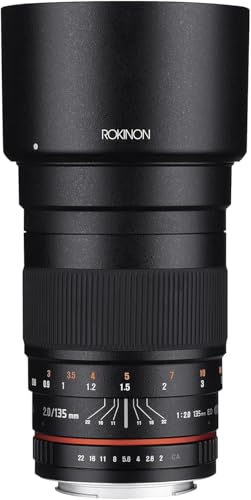
Rokinon 135mm f/2.0 Telephoto Lens
Best for: Canon DSLR portrait and detail photography
- Lens Mount
- Canon
- Focal Length
- 135mm
- Maximum Aperture
- F2.0
- Sensor Format
- Full frame, APS-C
- Lens Type
- Telephoto
- Minimum Focus Distance
- 2.6 ft.
This is a manual focus telephoto lens designed for Canon digital SLR cameras. It features a 135mm focal length with a maximum aperture of f/2.0. The optical design includes an extra-low dispersion element to reduce chromatic aberrations. It is compatible with both full frame and APS-C sensor formats. The lens weighs 1.8 pounds and measures 3.2 inches in length. It suits photographers seeking a dedicated portrait or detail lens.
- 135mm focal length provides telephoto reach
- f/2.0 maximum aperture allows for low light shooting
- Compatible with full frame and APS-C sensors
- Includes one extra-low dispersion lens element
- Features 9 diaphragm blades for smooth bokeh
- Heavier build at 1.8 pounds compared to typical kit lenses
- Longer physical length of 3.2 inches
- Manual focus only with no autofocus motor
- You want a dedicated telephoto lens for portraits
- You shoot with Canon DSLR bodies
- You prefer manual control over focus
- You need autofocus for fast action
- You require a compact travel lens
- You shoot exclusively with mirrorless bodies without an adapter
Verdict: Rokinon 135mm f/2.0 Telephoto Lens is a solid option for Canon DSLR users who prioritize optical quality and manual control. It fits those who want a sharp, fast telephoto prime for portraits or detail work.
Specifications side by side
| Spec | Canon EF 16-35mm f/2.8L II USM | Rokinon 135mm f/2.0 Telephoto Lens |
|---|---|---|
| Lens Mount | Canon EF | Canon |
| Focal Length | 16-35mm | 135mm |
| Maximum Aperture | f/2.8 | F2.0 |
| Sensor Format | – | Full frame, APS-C |
| Lens Type | ultra-wide-angle zoom | Telephoto |
| Minimum Focus Distance | 0.92 feet | 2.6 ft. |
| Recommended Usage | – | Photography, Photography & Video |
| Color | Black | Black |
| Intended Use | – | Video |
| Dimensions | 4.4 × 4.4 × 4.4 inches | 3.2 × 4.09 × 4.09 inches |
| Weight | 2.15 pounds | 1.8 pounds |
| Model | 1910B002 | 135M-C |
| Size | – | 77mm |
Frequently asked questions
Is Canon or Rokinon better for wide-angle shots?
Choose the Canon EF 16-35mm f/2.8L II USM for wide-angle work. It covers a 16mm to 35mm focal range. This makes it ideal for landscapes and architecture. The Rokinon 135mm is a telephoto lens. It does not offer wide-angle capabilities. You need a different lens for that purpose.
Which lens is lighter for travel?
The Rokinon 135mm f/2.0 Telephoto Lens is lighter. It weighs 1.8 pounds. The Canon EF 16-35mm f/2.8L II USM weighs 2.15 pounds. If you prioritize minimal weight, the Rokinon option is the better choice. The difference is roughly half a pound.
Can I use these lenses on any camera?
No, both lenses are designed specifically for Canon cameras. The Canon lens uses the Canon EF mount. The Rokinon lens is intended for Canon DSLR systems. You cannot mount these on Nikon, Sony, or other brand cameras without significant adapter limitations that may affect functionality.
What is the main difference in focal length?
The Canon lens is a zoom with a 16mm to 35mm range. It captures wide scenes. The Rokinon lens is a prime with a fixed 135mm focal length. It provides a narrow, telephoto view. You cannot zoom with the Rokinon lens. The Canon lens offers flexibility in framing.
Which lens is better for portraits?
The Rokinon 135mm f/2.0 Telephoto Lens is better for portraits. Its 135mm focal length compresses background elements nicely. The f/2.0 aperture allows for shallow depth of field. The Canon 16-35mm is too wide for standard portrait work. It distorts facial features if used too close.
Does the Canon lens have autofocus?
Yes, the Canon EF 16-35mm f/2.8L II USM features autofocus. The USM designation indicates an Ultrasonic Motor for fast focusing. The Rokinon 135mm is a manual focus lens. You must adjust focus by hand. This requires more skill but offers precise control over sharpness.
Are both lenses black in color?
Yes, both lenses are black. The Canon EF 16-35mm f/2.8L II USM is black. The Rokinon 135mm f/2.0 Telephoto Lens is also black. This provides a consistent aesthetic when switching between lenses. The color does not affect performance or optical quality.


