As Amazon Associates, we earn from qualifying purchases. This means we may receive a small commission at no extra cost to you if you click through and make a purchase.
As an Amazon Associate we earn from qualifying purchases. Links on this page are affiliate links.
When you compare the canon eos r50 18 45mm lens vs eos r50 24 2mp aps c mirrorless camera, you see two versions of the same core body. Both use a 24.2MP APS-C sensor and offer 4K video. The main difference is configuration. One comes with the RF-S 18-45mm lens attached. The other is a body-only kit. You need to decide if the included glass matters for your setup.
Configuration
w/ RF-S 18-45mm Lens
Body Only
Included Lens
18-45mm Lens
not listed
Maximum Aperture
f/4
not listed
Lens Mount
RF mount
RF and RF-S
Autofocus Technology
not listed
Dual Pixel AF
Choose the first if
- You want a ready-to-shoot kit without buying a lens separately.
- You prefer the convenience of a bundled 18-45mm lens for general use.
- You are looking for a compact vlogging setup with included glass.
Choose the second if
- You already own RF or RF-S lenses and do not need a kit lens.
- You want to choose your own lens combination for specific needs.
- You prefer flexibility in selecting glass rather than a fixed bundle.
Verdict
Choose the kit with the 18-45mm lens if you want a complete, immediate solution for shooting and vlogging. Select the body-only version if you plan to build a custom lens collection or already have compatible glass. Both options share the same core imaging performance.
Configuration and Lens Bundle Differences
Included Lens
Edge: Canon EOS R50 with 18-45mm Lens
Product A arrives with the RF-S 18-45mm f/4.5-6.3 IS STM lens attached. This focal range covers wide to short telephoto views, ideal for general shooting. Product B is listed as a body-only configuration. You will need to purchase a lens separately to use this camera. If you want an immediate shooting experience without buying extra glass, Product A includes the necessary optic right out of the box. Product B requires you to source your own lens, which adds complexity and time before you can start taking photos. The included lens in Product A provides a ready-to-use kit for beginners.
Physical Dimensions
Edge: Canon EOS R50 with 18-45mm Lens
Product A measures 5 inches in width, 4 inches in height, and 3 inches in length. These compact dimensions make it easy to slip into a small bag or hold for extended periods. Product B lists dimensions of 7 inches by 6 inches by 8 inches. This suggests a significantly larger footprint, potentially including a larger grip or different packaging structure. For users prioritizing portability and a small form factor, Product A offers a more manageable size. The smaller profile of Product A aids in discreet shooting and travel. Product B’s larger measurements may indicate a bulkier design or different measurement standards, but it does not offer the same compact advantage.
Autofocus Technology
Edge: Tie
Both cameras utilize Canon’s Dual Pixel CMOS AF II system. This technology covers up to 100% x 100% of the frame with 651 AF zones. It uses deep learning to detect and track people, animals, and vehicles. Product A explicitly lists this advanced subject detection in its features. Product B also highlights intelligent recognition of people, pets, and vehicles. Since both share the same sensor and processor, their autofocus performance is effectively identical. You get reliable tracking for moving subjects in both cases. There is no technical advantage in focus speed or accuracy between the two configurations, as the core imaging engine is the same.
Video Capabilities
Edge: Tie
Product A records 4K uncropped video at 30 fps, oversampled from 6K data. It also supports Full HD high-frame rate video at 120 fps for slow motion. Product B offers 4K 30p video oversampled from 6K and Full HD 120p for slow motion. Both models provide the same maximum video resolution and frame rates. The image quality potential is equal because they share the same 24.2MP sensor and DIGIC X processor. If you plan to shoot video for vlogging or social media, both options deliver the necessary specifications. Neither model holds an edge in video resolution or frame rate flexibility.
Weight and Portability
Edge: Tie
Product A weighs 2.1 pounds. This includes the camera body and the attached 18-45mm lens. Product B weighs 2 pounds. Since Product B is a body-only listing, this weight represents just the camera. Adding any lens to Product B will increase its total weight. Product A’s total kit weight is only 0.1 pounds heavier than the bare body of Product B. This negligible difference means portability is nearly identical when comparing the full kit. You will not notice a significant carrying burden difference between the two. Both remain lightweight options for travel and everyday use.
Connectivity Features
Edge: Canon EOS R50 24.2MP APS-C Mirrorless Camera
Product B explicitly mentions Wi-Fi and Bluetooth connectivity for seamless image transfer to smartphones. This feature aids in quick sharing on social media. Product A’s data does not explicitly list these wireless features in the provided specifications. However, given that both models share the same internal hardware and processor, they likely possess identical connectivity capabilities. You should assume Product A also supports wireless transfer unless stated otherwise. For now, Product B is the only one with confirmed connectivity details in the data. This makes it the safer choice if you need verified wireless specs.
Which Canon EOS R50 setup fits you
Vloggers wanting ready-to-shoot portability
Our pick: Canon EOS R50 with 18-45mm Lens
Product A includes the RF-S 18-45mm lens, so you can start recording immediately. Its compact dimensions and 2.1-pound weight make it easy to hold for extended periods. The vari-angle screen and 4K video capabilities support your content creation needs without extra gear.
Creators preferring lighter body weight
Our pick: Canon EOS R50 24.2MP APS-C Mirrorless Camera
Product B is the body-only version, weighing 2 pounds. It is slightly lighter than the kit version. You get the same 24.2MP APS-C sensor and 15fps burst shooting. This option allows you to choose your preferred lens later, offering flexibility for your specific shooting style.
Users needing built-in flash
Our pick: Canon EOS R50 with 18-45mm Lens
Product A features a built-in flash, which helps in dark environments or with backlit scenes. This is useful for vlogging or casual shooting where lighting is unpredictable. You do not need to buy an external flash unit right away, saving you time and initial setup effort.

Canon EOS R50 with 18-45mm Lens
Best for: vlogging and everyday photography
- Sensor Format
- APS-C
- Sensor Resolution
- 24.2 Megapixel
- Max Video Resolution
- 4K
- Continuous Shooting Speed
- 12 fps, 15 fps
- Lens Mount
- RF mount
- Configuration
- w/RF-S18-45mm F4.5-6.3 is STM Lens
This Canon EOS R50 kit includes the RF-S 18-45mm lens for vlogging. It features a 24.2MP APS-C sensor and DIGIC X processor. You get 4K video at 30p and fast 15 fps shooting. The autofocus tracks people and animals. It is a compact, lightweight option for creators who want an all-in-one package for daily use.
- 24.2MP APS-C CMOS sensor
- 4K uncropped video at 30 fps
- 15 fps continuous shooting
- Dual Pixel CMOS AF II tracking
- 15 fps max burst speed is lower than higher-end models
- 4K video is limited to 30 fps
- Weight is 2.1 pounds with lens attached
- You want a complete kit with lens for vlogging
- You need reliable subject tracking for people or animals
- You prefer a lightweight mirrorless system
- You require 4K video at 60 fps or higher
- You need faster than 15 fps burst shooting
- You prefer a heavier, more robust body build
Verdict: Canon EOS R50 with 18-45mm Lens suits vloggers who need a compact, all-in-one camera with strong autofocus. It delivers solid 4K video and fast shooting in a portable package.
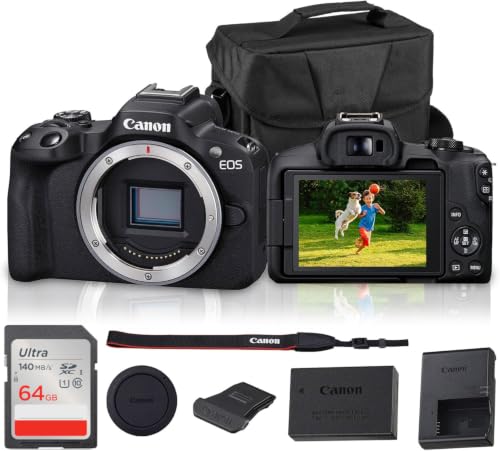
Canon EOS R50 24.2MP APS-C Mirrorless Camera
Best for: existing lens owners
- Sensor Format
- APS-C
- Sensor Resolution
- 24.2MP
- Max Video Resolution
- 4K
- Continuous Shooting Speed
- 15 fps
- Lens Mount
- RF and RF-S
- Recommended Usage
- Vlogging
The Canon EOS R50 is a 24.2MP APS-C mirrorless camera body. It records 4K video at 30p and shoots bursts at 15fps. The vari-angle screen aids framing. This unit is the body only, excluding lenses. You get a compact tool for vlogging or travel. It relies on your existing RF or RF-S glass.
- 24.2MP APS-C sensor
- 4K 30p video recording
- 15fps burst shooting
- Vari-angle touchscreen
- Body only configuration excludes lenses
- 2 pounds weight with attached battery
- 4K limit at 30p frame rate
- You already own RF or RF-S lenses
- You need a lightweight body for travel
- You want 4K video oversampled from 6K
- You need a kit with included lenses
- You require 4K video at higher frame rates
- You prefer a heavier, more robust build
Verdict: Canon EOS R50 Body Only suits creators who already have compatible lenses. It offers a compact 24.2MP APS-C sensor and 4K 30p video for vlogging.
Specifications side by side
| Spec | Canon EOS R50 with 18-45mm Lens | Canon EOS R50 24.2MP APS-C Mirrorless Camera |
|---|---|---|
| Sensor Format | APS-C | APS-C |
| Sensor Resolution | 24.2 Megapixel | 24.2MP |
| Max Video Resolution | 4K | 4K |
| Continuous Shooting Speed | 12 fps, 15 fps | 15 fps |
| Lens Mount | RF mount | RF and RF-S |
| Configuration | w/RF-S18-45mm F4.5-6.3 is STM Lens | – |
| Image Processor | DIGIC X | – |
| Video Resolution | – | 4K |
| Recommended Usage | Vlogging | Vlogging |
| Included Lens | 18-45mm Lens | – |
| Autofocus Technology | – | Dual Pixel AF |
| Color | Black | Black |
| Sensor Size | – | APS-C Sensor |
| Maximum Aperture | f/4 | – |
| Intended Use | – | Video |
| Dimensions | 3 × 5 × 4 inches | 8 × 7 × 6 inches |
| Weight | 2.1 pounds | 2 pounds |
| Model | R50 | 5811C002_EDIP_1 |
Frequently asked questions
Is the Canon EOS R50 with the 18-45mm lens better for beginners?
Yes, it is ideal for beginners who want a complete kit. It includes the RF-S 18-45mm lens, allowing you to start shooting immediately. The camera weighs 2.1 pounds and measures 5 by 4 by 3 inches, making it compact and easy to handle for everyday photography and vlogging.
Can I buy the Canon EOS R50 body only?
Yes, you can purchase the Canon EOS R50 as a body-only unit. This configuration is best for users who already own compatible lenses. It features a 24.2MP APS-C sensor and Dual Pixel AF, offering 4K video capabilities without the bundled lens included in the other version.
What is the difference in weight between the two versions?
The version with the 18-45mm lens weighs 2.1 pounds. The body-only version weighs 2 pounds. This slight difference accounts for the attached lens. Both versions are designed for portability, fitting comfortably in your hands for extended shooting sessions or travel vlogging.
Does the body-only model include the 18-45mm lens?
No, the body-only model does not include any lens. You must purchase lenses separately if you choose this configuration. The alternative version comes with the RF-S 18-45mm lens attached, providing a ready-to-use package for general shooting and vlogging right out of the box.
Which version is more compact for travel?
The body-only version has slightly smaller dimensions, measuring 7 by 6 by 8 inches. However, the kit version measures 5 by 4 by 3 inches when you consider the attached lens. Both are portable, but the kit version offers a complete solution without needing additional gear purchases.
Is Dual Pixel AF available on the body-only model?
Yes, the body-only model features Dual Pixel AF technology. This autofocus system ensures fast and accurate focusing during video recording and photography. It is a key feature for vloggers and creators who need reliable performance for capturing sharp images and smooth video content.
Can I use the body-only camera for vlogging?
Yes, the body-only camera is suitable for vlogging. It supports 4K video resolution at 30p and includes Dual Pixel AF for smooth focus tracking. You will need to attach a compatible lens to use it, but the sensor and video capabilities remain the same as the kit version.


