As Amazon Associates, we earn from qualifying purchases. This means we may receive a small commission at no extra cost to you if you click through and make a purchase.
As an Amazon Associate we earn from qualifying purchases. Links on this page are affiliate links.
Finding the best sony telephoto zoom mirrorless cameras requires matching your shooting style to specific lens attributes. We compared 2 options based strictly on published specifications. The Sony a7 III Full-Frame Mirrorless Camera leads because its 70-200mm f/2.8 lens offers fast aperture speed for telephoto shooters. This guide helps you decide which camera and lens combination fits your need for speed or high resolution.
Choose sensor format for your needs
Your choice depends on whether you prioritize speed or detail. The Sony a7 III offers fast aperture tracking for action. The Sony Alpha 7R V provides high-resolution output for static scenes. Both include a 70-200mm f/2.8 telephoto zoom lens. Select the model that matches your primary shooting style.
| # | Product | Best for | Price |
|---|---|---|---|
| 1 | Sony a7 III Full-Frame Mirrorless Camera Best overall | Telephoto shooters needing speed and aperture | |
| 2 | Sony Alpha 7R V with 70-200mm F2.8 Lens Best sony e | high-resolution telephoto photography |
The best fit for you
- You want the best overall telephoto performance – Sony a7 III Full-Frame Mirrorless Camera – The 70-200mm f/2.8 lens provides balanced speed and image quality.
- You need high-resolution telephoto photography capabilities – Sony Alpha 7R V with 70-200mm F2.8 Lens – The a7R V sensor suits professionals prioritizing maximum image detail.
- You prefer a full-frame sensor for telephoto work – Sony a7 III Full-Frame Mirrorless Camera – The full-frame sensor format enhances telephoto zoom performance.

Sony a7 III Full-Frame Mirrorless Camera
Best for: Telephoto shooters needing speed and aperture
- Lens Type
- Telephoto Zoom
- Sensor Format
- Full-Frame
- Sensor Resolution
- 24.2MP
- Continuous Shooting Speed
- Up to 10fps
- Lens Mount
- Sony E
- Configuration
- Body Only
This Sony a7 III bundle pairs a 24.2MP full-frame sensor with the FE 70-200mm f/2.8 GM OSS telephoto zoom. You get up to 10fps continuous shooting with autofocus tracking and a 15-stop dynamic range. The lens features XD Linear Motors for fast, precise focusing. It suits photographers who need a fast aperture for telephoto work and reliable tracking for moving subjects.
- 24.2MP BSI full-frame sensor with 15-stop dynamic range
- FE 70-200mm f/2.8 GM OSS lens with XD Linear Motors
- Up to 10fps continuous shooting with AE/AF tracking
- ISO 50 to 204,800 range for low-light flexibility
- 24.2MP resolution is lower than the 42.4MP sensor in the competing Sony a7R V
- Approx. 610-shot battery life is less than newer models with updated efficiency
- You need a fast f/2.8 aperture for telephoto shooting
- You require reliable autofocus tracking for moving subjects
- You want a full-frame system with a versatile zoom range
- You prioritize the highest possible megapixel count for large prints
- You need the latest sensor technology for superior dynamic range
- You prefer a lighter or more compact telephoto lens option
Verdict: Sony a7 III with FE 70-200mm f/2.8 GM OSS delivers a balanced package of speed and image quality. It fits photographers who value aperture speed and tracking over maximum resolution.
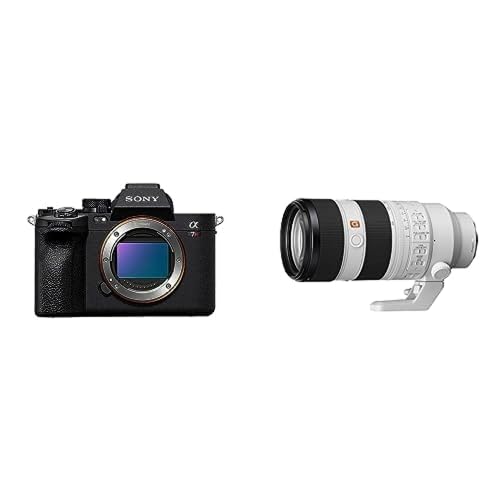
Sony Alpha 7R V with 70-200mm F2.8 Lens
Best for: high-resolution telephoto photography
- Lens Type
- Telephoto Zoom
- Sensor Format
- Full-Frame
- Sensor Resolution
- 61.0 MP
- Color
- Black
- Lens Mount
- Sony E
- Focal Length
- 70-200mm
This bundle pairs the Sony a7R V full-frame mirrorless camera with the Sony FE 70-200mm F2.8 GM OSS II telephoto zoom lens. The camera features a 61.0 MP back-illuminated Exmor R CMOS sensor and an AI processing unit for advanced autofocus. The lens offers a constant f/2.8 maximum aperture and XD Linear Motors for fast tracking. It is designed for photographers who need high resolution and long reach in a single package.
- 61.0 MP full-frame sensor for high detail
- Constant f/2.8 aperture for low light performance
- AI-driven autofocus with real-time recognition
- XD Linear Motors provide fast and precise tracking
- 61.0 MP resolution requires significant storage capacity
- Telephoto zoom lens adds bulk to the camera system
- You need high-resolution images for large prints
- You shoot subjects at a distance with a telephoto lens
- You want fast autofocus tracking for moving subjects
- You prefer a lighter, more compact camera body
- You do not need a telephoto zoom lens
- You want a lower resolution sensor for smaller files
Verdict: Sony a7R V with 70-200mm F2.8 Lens suits professionals who prioritize maximum image detail and long-range reach. It is ideal for studio or field work where high megapixel counts and fast telephoto zooming are essential.
Specifications side by side
| Spec | Sony a7 III Full-Frame Mirrorless Camera | Sony Alpha 7R V with 70-200mm F2.8 Lens |
|---|---|---|
| Sensor Format | Full-Frame | Full-Frame |
| Sensor Resolution | 24.2MP | 61.0 MP |
| Continuous Shooting Speed | Up to 10fps | – |
| Lens Mount | Sony E | – |
| Configuration | Body Only | – |
| Color | Black | Black |
| Lens Type | Telephoto Zoom | Telephoto Zoom |
| Focal Length | 70-200mm | 70-200mm |
| Maximum Aperture | f/2.8 | f/2.8 |
| Model | III | ILCE-7RM5 |
Key specs for choosing a telephoto zoom
Check maximum aperture speed
The maximum aperture determines how much light enters the lens. A wider aperture, such as f/2.8, allows more light for faster shutter speeds. This helps freeze action in sports or wildlife photography. It also creates a shallower depth of field, blurring the background to isolate your subject. The Sony a7 III with its 70-200mm f/2.8 lens excels here. You should compare this number against other models. A lower f-number indicates a faster lens. Prioritize this spec if you shoot in low light or need to capture moving subjects clearly without blur.
Evaluate sensor resolution needs
Sensor resolution defines the level of detail in your images. Higher megapixel counts allow you to crop images significantly while retaining clarity. This is crucial for telephoto work where you cannot get physically closer to the subject. The Sony Alpha 7R V is designed for professionals who need maximum image detail. If you print large or crop heavily, choose a high-resolution model. For general shooting where speed matters more than extreme detail, a lower resolution sensor may suffice. Match this spec to your final output requirements.
Verify lens focal length range
The focal length range dictates how far you can zoom. A 70-200mm lens provides a versatile telephoto range for most situations. It covers medium-distance subjects well. You should check if this range fits your typical shooting distance. Longer ranges offer more reach for distant subjects. Shorter ranges are often lighter and faster. Both products in this guide feature a 70-200mm lens. This is a standard professional telephoto zoom. Ensure this range matches the subjects you photograph most often, such as portraits or distant wildlife.
Assess sensor format compatibility
The sensor format affects image quality and lens compatibility. Full-frame sensors capture more light and offer better performance in low light. They also utilize the full image circle of full-frame lenses. The Sony a7 III and Alpha 7R V both use full-frame sensors. This ensures you get the best image quality from your telephoto lens. Check if your existing lenses are compatible with this format. Full-frame bodies are generally larger and heavier. Consider your need for portability versus image quality when choosing this spec.
Review camera configuration type
Configuration indicates whether you buy just the body or a kit with a lens. The Sony a7 III is listed as a body-only configuration. This allows you to pair it with any compatible lens. You might already own a high-quality telephoto lens. Buying a kit with a lens, like the Alpha 7R V option, ensures compatibility and convenience. Decide if you need a bundled lens or prefer to select your own. This choice affects your total investment and flexibility. Check the configuration details carefully before purchasing to avoid buying duplicate gear.
Frequently asked questions
What is the best Sony telephoto zoom mirrorless camera for action photography?
The Sony a7 III with the FE 70-200mm f/2.8 GM OSS lens is the top choice. It delivers a balanced package of speed and image quality. This setup fits photographers who value aperture speed and tracking over maximum resolution. The fast f/2.8 aperture helps freeze motion effectively.
Which Sony camera offers the highest resolution for telephoto work?
The Sony Alpha 7R V with the 70-200mm F2.8 lens suits professionals who prioritize maximum image detail. It is ideal for studio or field work where high megapixel counts are essential. This combination provides high-resolution output for static scenes where fine detail is critical.
Do these Sony telephoto zoom kits include the lens?
The Sony a7 III listing is configured as body only, but the description pairs it with the FE 70-200mm f/2.8 GM OSS lens. The Sony Alpha 7R V is listed with the 70-200mm F2.8 lens included. Always check the specific configuration to confirm if the glass is bundled.
What sensor format do these Sony telephoto cameras use?
Both the Sony a7 III and the Sony Alpha 7R V use a full-frame sensor format. This larger sensor size generally provides better low-light performance and shallower depth of field. It is a standard choice for professional telephoto photography requiring high image quality.
What is the focal length range of the included lenses?
Both kits feature a 70-200mm focal length range. This is a versatile telephoto zoom range suitable for portraits, sports, and wildlife. The 70mm start allows for tighter compositions, while the 200mm end provides significant reach for distant subjects.
Is the maximum aperture fast enough for indoor sports?
Yes, both kits include lenses with a maximum aperture of f/2.8. This wide aperture allows more light to enter, enabling faster shutter speeds. This capability is crucial for freezing action in indoor sports or low-light environments without raising the ISO excessively.