As Amazon Associates, we earn from qualifying purchases. This means we may receive a small commission at no extra cost to you if you click through and make a purchase.
As an Amazon Associate we earn from qualifying purchases. Links on this page are affiliate links.
Choosing the best camera lens for photography requires matching specifications to your shooting style. We compared 15 options based on published specs. The Sigma 18-35mm f/1.8 Art Lens leads because its f/1.8 maximum aperture delivers bright optics for Nikon APS-C users. This guide helps you decide which lens fits your needs. You can find versatile zooms, macro primes, and telephoto options. Each pick balances focal length, aperture speed, and weight. Review the details below to find the right tool for your camera system.
Match sensor format to your lens
Check the sensor format before buying. The Sigma 16mm f/1.4 and Sony E 15mm f/1.4 G are built for APS-C bodies. The Sirui VP-1 Vision Prime 35mm T1.4 covers full-frame sensors. Using the wrong format wastes money. Verify your camera’s sensor size matches the lens specifications to ensure proper coverage and image quality.
| # | Product | Best for | Price |
|---|---|---|---|
| 1 | Sigma 18-35mm f/1.8 Art Lens Best overall | Nikon APS-C wide-angle photography | |
| 2 | Rokinon 135mm f/2.0 Telephoto Lens Also great | Canon telephoto portrait photography | |
| 3 | Tamron 24-70mm F/2.8 G2 for Nikon Best 24-70mm | Nikon photographers needing versatile zoom | |
| 4 | Sigma 16mm f/1.4 Sony E Best budget | Wide angle landscape and low light photography | |
| 5 | Canon RF 24-70mm f/2.8 L is USM Best standard zoom | Canon mirrorless portrait and landscape photography | |
| 6 | Canon RF 70-200mm F2.8 L IS USM Lens Best premium | Canon RF full-frame telephoto photography | |
| 7 | Tokina 100mm f/2.8 Macro for Canon EF Also great | Canon EF macro photography and portraits | |
| 8 | Sigma 105mm f/2.8 DG DN Macro Art Best 105mm | Macro and portrait photography on Sony E-mount | |
| 9 | Sigma 28-70mm F2.8 DG DN Best 28-70mm lens | Sony E-mount standard zoom photography | |
| 10 | Sony E 15mm f/1.4 G APS-C Lens Best aps-c | APS-C wide-angle photography and video | |
| 11 | Sirui VP-1 Vision Prime 35mm T1.4 Best full-frame | documentary and portrait photography | |
| 12 | Tamron 16-30mm F/2.8 for Nikon Z Best nikon z | Nikon Z wide-angle travel photography | |
| 13 | Canon RF 50mm f/1.2 L USM Best 50mm | low-light portrait photography | |
| 14 | Sony 100mm F2.8 GM OSS Macro Also great | Sony macro photography with stabilization | |
| 15 | Canon EF-S 10-22mm f/3.5-4.5 USM Best wide-angle zoom | APS-C DSLR landscape and interior photography |
The best fit for you
- You need a versatile lens for Nikon APS-C cameras – Sigma 18-35mm f/1.8 Art Lens – Its f/1.8 maximum aperture provides bright optics for wide-angle photography.
- You shoot portraits on a Canon mirrorless system – Canon RF 24-70mm f/2.8 L is USM – This standard zoom offers a versatile range for portraits and landscapes.
- You want the lightest lens for Sony E-mount – Sigma 28-70mm F2.8 DG DN – Weighing 1.04 pounds, it offers a balanced focal range for travel.
- You need a dedicated macro lens for Canon EF bodies – Tokina 100mm f/2.8 Macro for Canon EF – Its 100mm focal length and f/2.8 aperture suit close-up work.

Sigma 18-35mm f/1.8 Art Lens
Best for: Nikon APS-C wide-angle photography
- Recommended Usage
- Photography
- Lens Mount
- Nikon
- Focal Length
- 18-35mm
- Maximum Aperture
- F1.8
- Sensor Format
- APS-C
- Color
- Black
This Sigma lens covers 18-35mm with a constant f/1.8 aperture. It is built for APS-C sensors and features internal focusing and zooming. The wide range suits landscapes, portraits, and close-ups. At 1.79 pounds, it is a substantial piece of glass. You get bright low-light performance and versatile framing on compatible Nikon bodies.
- Constant f/1.8 maximum aperture
- 18-35mm focal length range
- Internal focusing and zooming design
- Designed for APS-C sensors
- Weighs 1.79 pounds
- Limited to APS-C sensor format
- Length measures 4.76 inches
- You shoot with Nikon APS-C cameras
- You need a fast aperture for low light
- You want a versatile wide-angle zoom
- You use full-frame cameras
- You prefer lighter gear under one pound
- You need telephoto reach beyond 35mm
Verdict: Sigma 18-35mm f/1.8 Art Lens delivers bright optics for Nikon APS-C users. It fits photographers who prioritize speed and versatility over compact size.
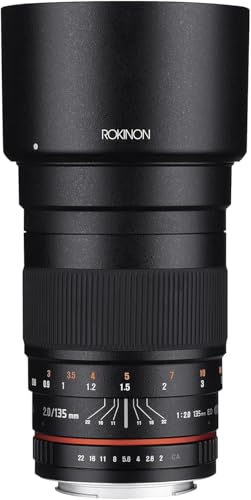
Rokinon 135mm f/2.0 Telephoto Lens
Best for: Canon telephoto portrait photography
- Recommended Usage
- Photography, Photography & Video
- Lens Mount
- Canon
- Focal Length
- 135mm
- Maximum Aperture
- F2.0
- Sensor Format
- Full frame, APS-C
- Lens Type
- Telephoto
The Rokinon 135mm f/2 is a telephoto lens for Canon cameras. It features a bright f/2.0 maximum aperture and a 135mm focal length. The lens includes one extra-low dispersion element to reduce chromatic aberration. It weighs 1.8 pounds and measures 3.2 inches long. You get a minimum focusing distance of 2.6 feet. This setup suits portrait and isolation photography on full-frame or APS-C bodies.
- f/2.0 maximum aperture for low light
- 135mm focal length for telephoto reach
- 9-blade diaphragm for smooth bokeh
- Includes removable lens hood
- Full frame and APS-C compatible
- 1.8 pounds is heavier than standard zooms
- 2.6 ft minimum focus distance is longer than macro lenses
- Manual focus operation only
- You need a fast telephoto for portraits
- You shoot with Canon DSLR bodies
- You want a lightweight prime option
- You require autofocus for sports
- You need a wider angle of view
- You shoot exclusively with mirrorless cameras
Verdict: Rokinon 135mm f/2 Telephoto Lens delivers sharp telephoto performance for Canon users. It fits photographers who prioritize aperture speed and manual control over autofocus convenience.

Tamron 24-70mm F/2.8 G2 for Nikon
Best for: Nikon photographers needing versatile zoom
- Recommended Usage
- Photography
- Lens Mount
- Nikon
- Focal Length
- 24-70mm
- Maximum Aperture
- f/2.8
- Lens Type
- Zoom
- Minimum Focus Distance
- 0.38 m (15 in)
This Tamron lens covers a 24-70mm focal range with a constant f/2.8 aperture. It includes a dedicated MPU for image stabilization rated at 5 CIPA stops. The fluorine coating and moisture-resistant construction help protect the lens in various conditions. You can focus as close as 0.38 meters. It weighs 1.98 pounds and measures 4.3 inches in length. This standard zoom is built for Nikon mount cameras.
- 5 CIPA-rated stops of image stabilization
- Constant f/2.8 maximum aperture
- 0.38 m minimum focus distance
- Fluorine and moisture-resistant coating
- 1.98 pounds weight is heavier than many primes
- 4.3 inches length is bulkier than compact lenses
- Nikon mount limits use to Nikon cameras
- You shoot with Nikon DSLRs
- You need versatile 24-70mm coverage
- You want built-in image stabilization
- You use Sony or Canon mounts
- You prefer ultra-lightweight primes
- You need macro magnification
Verdict: Tamron 24-70mm F/2.8 G2 for Nikon delivers reliable stabilization and a versatile zoom range for Nikon shooters. It fits users who need a single lens for general photography tasks.

Sigma 16mm f/1.4 Sony E
Best for: Wide angle landscape and low light photography
- Lens Mount
- Sony E
- Focal Length
- 16mm
- Maximum Aperture
- f/1.4
- Color
- Black
- Dimensions
- 9 × 7 × 7 inches
- Weight
- 14.3 ounces
This Sigma lens offers a 16mm focal length with a wide f/1.4 maximum aperture. It is designed for Sony E mount cameras. The large aperture helps in low light. The compact build makes it portable for travel. You can use it for landscapes and events. It supports fast hybrid autofocus for quick shooting.
- f/1.4 maximum aperture for low light
- 16mm focal length for wide angles
- Compact and portable design
- Compatible with Sony E mount
- Heavier at 14.3 ounces than many primes
- Fixed 16mm focal length limits zoom flexibility
- Larger physical dimensions than standard kit lenses
- You need a wide angle for landscapes
- You shoot in low light conditions
- You use a Sony E mount camera
- You require a zoom lens for versatility
- You prefer a lighter weight for travel
- You shoot with Canon or Nikon mounts
Verdict: Sigma 16mm f/1.4 Sony E provides a bright aperture for wide shots. It suits Sony users who prioritize low light performance and portability over zoom range.

Canon RF 24-70mm f/2.8 L is USM
Best for: Canon mirrorless portrait and landscape photography
- Recommended Usage
- Photography
- Lens Mount
- Canon RF
- Focal Length
- 24-70mm
- Maximum Aperture
- f/2.8
- Lens Type
- Standard Zoom
- Image Stabilization
- Optical Image Stabilization
This Canon RF standard zoom lens covers 24-70mm with a constant f/2.8 aperture. It features Nano USM autofocus and optical image stabilization rated at 5 stops. The lens weighs 1.98 pounds and measures 4.95 inches in length. You get a control ring for quick adjustments. It suits portrait and landscape photography on Canon mirrorless cameras.
- Constant f/2.8 maximum aperture throughout the zoom range
- Optical image stabilization provides up to 5 stops of shake correction
- Nano USM motor delivers high-speed and quiet autofocus
- Control ring allows direct setting changes
- Heavier build at 1.98 pounds compared to lighter primes
- Minimum focus distance is 0.21 m at the wide end
- Fixed f/2.8 aperture limits light gathering compared to f/1.8 options
- You shoot portraits and landscapes with Canon RF bodies
- You need versatile focal length coverage in one lens
- You value optical image stabilization for handheld shots
- You require a wider maximum aperture like f/1.8
- You prioritize ultra-lightweight gear for travel
- You use Nikon or Sony camera mounts
Verdict: Canon RF 24-70mm f/2.8 L is USM offers reliable image quality and stabilization for photographers who need a versatile standard zoom. It fits those who shoot portraits and landscapes on Canon mirrorless systems.

Canon RF 70-200mm F2.8 L IS USM Lens
Best for: Canon RF full-frame telephoto photography
- Recommended Usage
- Photography
- Lens Mount
- Canon RF
- Focal Length
- 70-200mm
- Maximum Aperture
- f/2.8
- Sensor Format
- Full Frame
- Lens Type
- Telephoto Zoom
This Canon RF 70-200mm f/2.8 lens is a telephoto zoom designed for full-frame mirrorless cameras. It features a constant f/2.8 maximum aperture and dual Nano USM autofocus for speed. The lens includes optical image stabilization with up to 5 stops of correction. Weighing 2.64 pounds, it balances performance with portability. You will appreciate the 2.3 ft minimum focusing distance for close subjects.
- Constant f/2.8 maximum aperture for low light
- Optical image stabilization up to 5 stops
- Dual Nano USM autofocus system
- 2.3 ft minimum focusing distance
- Weighs 2.64 pounds, heavier than many primes
- 70-200mm focal range is narrower than 18-35mm or 24-70mm zooms
- You need a bright telephoto zoom for Canon RF
- You shoot sports or wildlife requiring reach and stabilization
- You want consistent f/2.8 performance across the zoom range
- You use Sony or Nikon mirrorless cameras
- You prefer a wider angle like 16-35mm for landscapes
- You need a lighter prime lens under 1 pound
Verdict: Canon RF 70-200mm f/2.8 Telephoto Lens offers professional reach and stabilization for Canon shooters. It fits those who prioritize aperture speed and image stabilization over minimal weight.

Tokina 100mm f/2.8 Macro for Canon EF
Best for: Canon EF macro photography and portraits
- Recommended Usage
- Photography
- Lens Mount
- Canon EF
- Focal Length
- 100mm
- Maximum Aperture
- f/2.8
- Sensor Format
- Full Size
- Lens Type
- Macro
This Tokina macro lens offers a 100mm focal length with an f/2.8 maximum aperture. It is designed for full-size sensors and mounts to Canon EF cameras. The lens includes a One-Touch Focus Clutch mechanism for quick mode switching. Its 1.14-pound weight and 3.74-inch length make it a manageable tool for portraits and landscapes. You get straightforward bokeh and medium telephoto versatility in one package.
- 100mm focal length ideal for macro work
- f/2.8 maximum aperture for light gathering
- One-Touch Focus Clutch for fast mode switching
- Suitable for portraits and landscapes
- Heavier at 1.14 pounds compared to lighter primes
- Longer at 3.74 inches than compact options
- Fixed f/2.8 aperture limits background blur control
- You need a dedicated macro lens for Canon EF bodies
- You want a versatile tool for portraits and landscapes
- You value quick focus mode switching without stopping rotation
- You shoot with Sony E or Nikon Z mounts
- You require a zoom lens for variable framing
- You need a lens lighter than 1 pound
Verdict: Tokina 100mm f/2.8 Macro for Canon EF suits photographers who need a sturdy, dedicated macro lens for Canon EF bodies. It delivers reliable 100mm reach and f/2.8 performance for close-up work and portraits.

Sigma 105mm f/2.8 DG DN Macro Art
Best for: Macro and portrait photography on Sony E-mount
- Lens Mount
- Sony E-mount
- Focal Length
- 105mm
- Maximum Aperture
- f/2.8
- Sensor Format
- Full-frame
- Lens Type
- Short tele macro
- Maximum Magnification
- 1:1
This Sigma 105mm f/2.8 DG DN Macro Art lens is a short telephoto prime designed for full-frame Sony E-mount cameras. It offers a maximum aperture of f/2.8 and 1:1 life-sized magnification for macro work. The lens weighs 1.58 pounds and measures 5.26 inches in length. It includes a focus limiter and a de-clickable aperture ring. This tool suits photographers needing precise close-up capabilities and portrait performance on mirrorless bodies.
- 1:1 maximum magnification for life-sized macro reproduction
- Hypersonic Motor provides smooth and accurate autofocus
- Clicked and de-clicked aperture ring with lock switch
- Focus Limiter switch for macro, portrait, or full range
- Fixed 105mm focal length limits framing flexibility
- 1.58 pounds weight is heavier than standard zooms
- f/2.8 maximum aperture is narrower than f/1.8 primes
- You need 1:1 macro magnification on a Sony E-mount camera
- You want a dedicated short telephoto lens for portraits
- You prefer manual aperture control with a de-clicked ring
- You require a zoom lens for variable framing
- You need a wider aperture for low-light performance
- You are using an APS-C camera body
Verdict: Sigma 105mm f/2.8 DG DN Macro Art delivers specialized macro and portrait performance for Sony E-mount users. It fits photographers who prioritize 1:1 magnification and manual aperture control over zoom versatility.

Sigma 28-70mm F2.8 DG DN
Best for: Sony E-mount standard zoom photography
- Recommended Usage
- Photography, Travel
- Lens Mount
- Sony E
- Focal Length
- 28-70mm
- Maximum Aperture
- f/2.8
- Included Lens
- 28-70mm Lens
- Color
- Black
This Sigma lens offers a 28-70mm focal range with a constant f/2.8 maximum aperture, making it a versatile standard zoom for Sony E-mount cameras. Weighing 1.04 pounds, it balances portability with professional-grade optics. The internal focusing mechanism and Nano Porous Coating help maintain a compact profile while ensuring sharp images. It suits photographers who need a reliable all-around lens for travel and general photography without excessive bulk.
- Constant f/2.8 maximum aperture for consistent exposure
- Lightweight 1.04 pounds body for easier handling
- Internal focusing mechanism keeps size stable
- Nano Porous Coating reduces flare and ghosting
- Heavier than the Sigma 16mm f/1.4 at 1.04 pounds
- Maximum aperture f/2.8 is slower than f/1.2 or f/1.4 options
- Fixed 28-70mm range limits wide-angle reach compared to 18-35mm
- You shoot with Sony E-mount cameras
- You need a standard zoom for travel
- You prefer a constant f/2.8 aperture
- You use Canon or Nikon mounts
- You require ultra-wide angles below 28mm
- You need a faster f/1.4 or wider aperture
Verdict: Sigma 28-70mm F2.8 DG DN provides a balanced focal range and aperture for Sony users. It fits photographers who prioritize a versatile standard zoom over extreme wide-angle or telephoto capabilities.

Sony E 15mm f/1.4 G APS-C Lens
Best for: APS-C wide-angle photography and video
- Recommended Usage
- Photography, Photography & Video
- Lens Mount
- E-mount
- Focal Length
- 15mm
- Maximum Aperture
- f/1.4
- Sensor Format
- APS-C
- Lens Type
- Wide-angle prime
The Sony E 15mm f/1.4 G is an APS-C wide-angle prime lens designed for photographers and videographers using E-mount cameras. Its large f/1.4 maximum aperture allows for excellent low-light performance and shallow depth of field. The lens features fast autofocus driven by two linear motors and includes a customizable aperture ring with click-stop switching. Weighing 13.3 ounces, it offers a compact form factor with a constant length during focusing for balanced handling.
- Large f/1.4 maximum aperture for low light and background separation
- Two linear motors provide fast and precise autofocus tracking
- Aperture ring includes a switch to toggle click stops for video silence
- Constant lens length during focusing maintains balance and handling
- 15mm focal length is fixed and cannot zoom
- 13.3-ounce weight is heavier than many compact APS-C primes
- Aperture ring click toggle requires manual adjustment for each shooting mode
- You need a wide perspective for landscapes or architecture on APS-C bodies
- You shoot in low-light conditions and require an f/1.4 aperture
- You want tactile control over exposure settings via an aperture ring
- You require a zoom lens to vary your framing without moving
- You use full-frame cameras where this lens will crop significantly
- You prefer silent autofocus without the option to enable click stops
Verdict: Sony E 15mm f/1.4 G Wide Angle is a solid choice for APS-C users who prioritize wide-angle coverage and fast aperture. It suits photographers who value manual aperture control and consistent handling during focus.

Sirui VP-1 Vision Prime 35mm T1.4
Best for: documentary and portrait photography
- Recommended Usage
- Photography
- Focal Length
- 35mm
- Maximum Aperture
- T1.4
- Sensor Format
- Full Frame
- Lens Type
- Prime
- Color
- Black
This Sirui 35mm prime lens is designed for full-frame cameras and offers a fast T1.4 aperture. It features interchangeable mounts for E, RF, Z, and L systems. The aluminum alloy body weighs around 600g. You get edge-to-edge sharpness with minimal distortion. This lens suits documentary and portrait work. Its compact size helps with handheld stabilization. The consistent design aids multi-lens setups.
- Fast T1.4 aperture for low-light shooting
- Interchangeable mount system for multiple camera brands
- Full-frame sensor format support
- Aluminum alloy body weighs around 600g
- Includes aspherical and ED glass elements
- Heavier build at around 600g compared to lighter primes
- Fixed 35mm focal length limits zoom flexibility
- Larger physical dimensions than standard compact primes
- You need a fast lens for low-light documentary work
- You shoot with interchangeable mount systems like Sony E or Canon RF
- You want a consistent lens for multi-camera setups
- You require a zoom lens for variable framing
- You prioritize ultra-lightweight gear for long hikes
- You shoot primarily with APS-C sensors only
Verdict: Sirui VP-1 Vision Prime 35mm T1.4 fits documentary filmmakers and portrait photographers who need fast light gathering and mount versatility. Its solid build and consistent design make it ideal for professional video and photo projects requiring reliable performance.

Tamron 16-30mm F/2.8 for Nikon Z
Best for: Nikon Z wide-angle travel photography
- Recommended Usage
- Photography, Travel
- Lens Mount
- Nikon Z
- Focal Length
- 16-30mm
- Maximum Aperture
- f/2.8
- Lens Type
- Zoom
- Color
- Black
This is a compact wide-angle zoom lens for Nikon Z cameras. It offers a 16-30mm focal range and a constant f/2.8 maximum aperture. The VXD autofocus system ensures high-speed, high-precision focusing. Weighing 15.9 ounces, it features moisture-resistant construction and a fluorine coating. It suits photographers and videographers who prioritize lightweight mobility and sharp optical performance for landscapes or architecture.
- Constant f/2.8 maximum aperture across the 16-30mm zoom range
- Lightweight 15.9 ounces build for easy travel
- VXD autofocus for high-speed and high-precision focusing
- Moisture-resistant construction with fluorine coating
- f/2.8 maximum aperture is slower than the f/1.8 or f/1.2 options on this list
- 16-30mm focal length is narrower than the 18-35mm or 24-70mm zooms available elsewhere
- 15.9 ounces weight is heavier than some prime lenses in the guide
- You shoot with a Nikon Z mirrorless camera
- You need a lightweight wide-angle zoom for travel
- You value consistent f/2.8 aperture for low light
- You use Canon or Sony camera mounts
- You require a faster f/1.8 or wider f/1.4 aperture
- You prefer a longer telephoto zoom range
Verdict: Tamron 16-30mm F/2.8 for Nikon Z fits Nikon Z users who want a sharp, lightweight wide-angle zoom. It delivers reliable performance for travel and landscape photography without the bulk of larger glass.

Canon RF 50mm f/1.2 L USM
Best for: low-light portrait photography
- Recommended Usage
- Photography
- Lens Mount
- Canon RF
- Focal Length
- 50mm
- Maximum Aperture
- f/1.2
- Lens Type
- Prime
- Intended Use
- Portraits
This Canon RF 50mm f/1.2 L USM is a prime lens designed for photography. It features a wide f/1.2 maximum aperture and a 50mm focal length. The lens weighs 3 pounds and measures 9 inches in length. You will get sharp focus and shallow depth of field. It suits portrait and low-light photography needs on Canon RF cameras.
- f/1.2 maximum aperture for low light
- 50mm focal length for natural perspective
- USM motor for quiet autofocus
- L-Series optics for high sharpness
- 3 pound weight is heavier than zoom lenses
- 9 inch length is bulky for travel
- Fixed 50mm focal length limits framing options
- You need shallow depth of field for portraits
- You shoot in low-light conditions
- You use Canon RF mount cameras
- You prefer lightweight gear for travel
- You need variable focal length flexibility
- You shoot video requiring silent operation only
Verdict: Canon RF 50mm f/1.2 L USM delivers exceptional low-light performance and portrait quality for Canon RF users who prioritize image quality over portability.

Sony 100mm F2.8 GM OSS Macro
Best for: Sony macro photography with stabilization
- Recommended Usage
- Photography
- Lens Mount
- Sony E-Mount
- Focal Length
- 100mm
- Maximum Aperture
- F2.8
- Lens Type
- Macro Lens
- Image Stabilization
- OSS
This Sony macro lens offers 1.4x magnification and f/2.8 aperture for detailed photography. It features Optical SteadyShot stabilization to reduce shake during close-up work. The 100mm focal length provides a comfortable working distance. You get fast autofocus from four XD Linear motors. It weighs 1.42 pounds and measures 5.82 inches long. This tool suits photographers needing high resolution and precise focus control.
- 1.4x maximum magnification for close-up detail
- f/2.8 maximum aperture for light gathering
- Optical SteadyShot image stabilization reduces blur
- Four XD Linear AF motors for speed
- 1.42 pound weight is heavier than standard primes
- 100mm focal length limits wide-angle versatility
- 5.82 inch length adds bulk to the kit
- You need high magnification for macro subjects
- You shoot with Sony E-mount cameras
- You want stabilization for handheld close-ups
- You require a wider angle of view
- You need a lighter lens for travel
- You use a camera mount other than Sony E
Verdict: Sony 100mm F2.8 GM OSS Macro delivers sharp macro results with stabilization. It fits Sony users who prioritize magnification and weight over compactness.

Canon EF-S 10-22mm f/3.5-4.5 USM
Best for: APS-C DSLR landscape and interior photography
- Recommended Usage
- Photography, Travel
- Focal Length
- 10-22mm
- Maximum Aperture
- f/3.5-4.5
- Sensor Format
- APS-C
- Lens Type
- Ultra-Wide Angle Zoom
- Lens Mount
- Canon EF
This Canon ultra-wide zoom covers 10-22mm on APS-C bodies, giving you a 16-35.2mm equivalent field of view. It uses a ring-type USM for fast autofocus and includes Super-UD and aspherical elements to control aberrations. The lens weighs 2 pounds and measures 4x4x4 inches. It suits photographers who need expansive compositions for landscapes and interiors.
- 10-22mm focal length provides 16-35.2mm equivalent coverage
- Ring-type Ultrasonic Motor ensures fast, near-silent autofocus
- Super-UD and aspherical elements correct chromatic aberration
- Internal focusing keeps lens length constant
- Maximum aperture of f/3.5-4.5 is slower than many competitors
- Weight of 2 pounds is heavier than typical APS-C lenses
- Physical dimensions of 4x4x4 inches are bulkier than standard zooms
- You shoot landscapes or architecture on APS-C DSLRs
- You need a wide field of view for interiors
- You prioritize fast autofocus speed over low-light aperture
- You use full-frame cameras
- You require a constant f/2.8 or wider aperture
- You need a compact travel lens under 1 pound
Verdict: Canon EF-S 10-22mm f/3.5-4.5 USM fits APS-C DSLR users who need a dedicated ultra-wide angle for landscapes and interiors. Its wide coverage and fast focus make it useful for creative perspectives, despite its heavier build.
Specifications side by side
| Spec | Sigma 18-35mm f/1.8 Art Lens | Rokinon 135mm f/2.0 Telephoto Lens | Tamron 24-70mm F/2.8 G2 for Nikon | Sigma 16mm f/1.4 Sony E | Canon RF 24-70mm f/2.8 L is USM | Canon RF 70-200mm F2.8 L IS USM Lens | Tokina 100mm f/2.8 Macro for Canon EF | Sigma 105mm f/2.8 DG DN Macro Art | Sigma 28-70mm F2.8 DG DN | Sony E 15mm f/1.4 G APS-C Lens | Sirui VP-1 Vision Prime 35mm T1.4 | Tamron 16-30mm F/2.8 for Nikon Z | Canon RF 50mm f/1.2 L USM | Sony 100mm F2.8 GM OSS Macro | Canon EF-S 10-22mm f/3.5-4.5 USM |
|---|---|---|---|---|---|---|---|---|---|---|---|---|---|---|---|
| Lens Mount | Nikon | Canon | Nikon | Sony E | Canon RF | Canon RF | Canon EF | Sony E-mount | Sony E | E-mount | – | Nikon Z | Canon RF | Sony E-Mount | – |
| Focal Length | 18-35mm | 135mm | 24-70mm | 16mm | 24-70mm | 70-200mm | 100mm | 105mm | 28-70mm | 15mm | 35mm | 16-30mm | 50mm | 100mm | 10-22mm |
| Maximum Aperture | F1.8 | F2.0 | f/2.8 | f/1.4 | f/2.8 | f/2.8 | f/2.8 | f/2.8 | f/2.8 | f/1.4 | T1.4 | f/2.8 | f/1.2 | F2.8 | f/3.5-4.5 |
| Sensor Format | APS-C | Full frame, APS-C | – | – | – | Full Frame | Full Size | Full-frame | – | APS-C | Full Frame | – | – | – | APS-C |
| Lens Type | – | Telephoto | Zoom | – | Standard Zoom | Telephoto Zoom | Macro | Short tele macro | – | Wide-angle prime | Prime | Zoom | Prime | Macro Lens | Ultra-Wide Angle Zoom |
| Image Stabilization | – | – | – | – | Optical Image Stabilization | Optical Image Stabilization | – | – | – | – | – | – | – | OSS | – |
| Minimum Focus Distance | – | 2.6 ft. | 0.38 m (15 in) | – | 0.21 m (wide), 0.38 m (tele) | 2.3 ft / 0.7 m | – | – | – | – | – | – | – | – | – |
| Maximum Magnification | – | – | – | – | – | – | – | 1:1 | – | – | – | – | – | 1.4x | – |
| Recommended Usage | Photography | Photography, Photography & Video | Photography | – | Photography | Photography | Photography | – | Photography, Travel | Photography, Photography & Video | Photography | Photography, Travel | Photography | Photography | Photography, Travel |
| Included Lens | – | – | – | – | – | – | – | – | 28-70mm Lens | – | – | – | – | – | – |
| Color | Black | Black | Black | Black | Black | Silver | Black | Black | Black | Black | Black | Black | – | Black | – |
| Sensor Size | – | – | – | – | – | – | – | – | – | APS-C Sensor | – | – | – | – | – |
| Intended Use | Video | Video | Portraits, Landscapes | – | Portraits, Landscapes | Landscapes | Portraits, Landscapes | – | – | Video | Portraits | Video | Portraits | Video, Portraits | Landscapes |
| Dimensions | 4.76 × 3.07 × 3.07 inches | 3.2 × 4.09 × 4.09 inches | 4.3 × 3.5 × 3.5 inches | 9 × 7 × 7 inches | 4.95 × 3.48 × 3.48 inches | 5.75 × 3.54 × 3.54 inches | 2.87 × 2.87 × 3.74 inches | 5.26 × 2.91 × 2.91 inches | 3.94 × 2.83 × 2.83 inches | 12.6 × 11.7 × 7.28 inches | 4.25 × 4.25 × 4.25 inches | 4.1 × 2.94 × 2.94 inches | 9 × 5 × 5 inches | 5.82 × 3.2 × 3.2 inches | 4 × 4 × 4 inches |
| Weight | 1.79 pounds | 1.8 pounds | 1.98 pounds | 14.3 ounces | 1.98 pounds | 2.64 pounds | 1.14 pounds | 1.58 pounds | 1.04 pounds | 13.3 ounces | – | 15.9 ounces | 3 pounds | 1.42 pounds | 2 pounds |
| Size | 5.00 | 77mm | Nikon | 16 | 70mm | 5.8" | 4.60 | Medium | medium | 3.43 | 35 mm | 4.90 | – | 5.50 | – |
| Model | 210306 | 135M-C | AFA032N700 | 402965 | 3680C005 | 3792C002 | TO1-ATXI100MC | 260965 | 529965 | SEL15F14G | – | AFA064Z700 | – | SEL100M28GM | 9518A002_EDIP_1 |
If you need a camera body too, compare the best lens kit mirrorless cameras by mount type.
How to choose the right lens
Check the lens mount
Your camera body determines which lenses fit. The Canon RF 50mm f/1.2 L USM requires a Canon RF mount. It will not work on older Canon EF DSLRs. The Sigma 16mm f/1.4 Sony E is designed for Sony E-mount cameras. You must verify the mount type before purchasing. Mismatched mounts prevent installation. Check your camera manual or body label. This ensures physical compatibility. Avoid buying lenses that require adapters unless you already own them. The adapter adds bulk and cost. Direct mount connections provide the most reliable performance for your specific system.
Evaluate maximum aperture
The maximum aperture controls light intake and depth of field. A lower f-number means more light. The Sigma 18-35mm f/1.8 Art Lens offers an f/1.8 maximum aperture. This is ideal for low-light situations. The Canon EF-S 10-22mm f/3.5-4.5 USM has a variable aperture. It lets in less light at the long end. Fast apertures like f/1.2 on the Canon RF 50mm allow shooting in dim environments. They also create blurred backgrounds. Slower apertures like f/2.8 are common in zooms. Choose based on your typical lighting conditions.
Select focal length
Focal length defines your field of view. Wide-angle lenses like the Tamron 16-30mm F/2.8 for Nikon Z capture more scene. They suit landscapes and interiors. Telephoto lenses like the Rokinon 135mm f/2.0 Telephoto Lens magnify distant subjects. They work well for portraits. Standard zooms like the Tamron 24-70mm F/2.8 G2 for Nikon cover a versatile range. They are good for general photography. Prime lenses like the Sirui VP-1 Vision Prime 35mm T1.4 have fixed focal lengths. They often offer better image quality. Match the focal length to your primary shooting genre.
Consider lens weight
Weight affects portability and handling comfort. Heavier lenses provide robust build quality but cause fatigue. The Canon RF 70-200mm F2.8 L IS USM Lens weighs 2.64 pounds. It is substantial for long shoots. The Sigma 28-70mm F2.8 DG DN is lighter at 1.04 pounds. It is easier to carry for travel. The Sigma 16mm f/1.4 Sony E weighs just 14.3 ounces. It is highly portable. Check the weight in your chosen unit. Lighter lenses allow longer shooting sessions without strain. Heavier lenses may offer better weather sealing. Balance weight with your intended use.
Match intended use
Lenses are optimized for specific tasks. Macro lenses like the Sigma 105mm f/2.8 DG DN Macro Art provide 1:1 magnification. They are essential for close-up details. The Tokina 100mm f/2.8 Macro for Canon EF also serves this purpose. Standard zooms like the Canon RF 24-70mm f/2.8 L is USM are versatile for portraits and landscapes. Video-focused lenses like the Sony E 15mm f/1.4 G APS-C Lens offer smooth focus. Check the intended use in the specs. Do not buy a macro lens for general travel. Align the lens type with your creative goals.
Frequently asked questions
Which lens is best for low light photography?
The Canon RF 50mm f/1.2 L USM offers exceptional low-light performance. Its f/1.2 maximum aperture gathers significant light for portrait photography. The Sigma 18-35mm f/1.8 Art Lens is another strong option for Nikon APS-C users. It provides bright optics and speed for wide-angle shots in dim conditions.
What is the lightest camera lens on this list?
The Sigma 28-70mm F2.8 DG DN for Sony E-mount is the lightest option at 1.04 pounds. It provides a balanced focal range for standard zoom photography. The Sony E 15mm f/1.4 G APS-C Lens is also lightweight at 13.3 ounces. It suits wide-angle photography and video work for APS-C bodies.
Which lens is ideal for macro photography?
The Sigma 105mm f/2.8 DG DN Macro Art delivers specialized macro performance for Sony E-mount users. It features 1:1 magnification for close-up details. The Sony 100mm F2.8 GM OSS Macro is another excellent choice. It includes optical stabilization and sharp results for macro and portrait photography on Sony cameras.
Do I need a specific lens mount for my camera?
Yes, the lens mount must match your camera body. The Canon RF 50mm f/1.2 L USM requires a Canon RF mount. It will not fit older Canon EF DSLRs. The Sigma 16mm f/1.4 is designed for Sony E-mount bodies. Always verify your mount type before purchasing to ensure compatibility.
Which lens provides the best stabilization for handheld shots?
The Tamron 24-70mm F/2.8 G2 for Nikon delivers reliable stabilization. It helps maintain sharp images during handheld shooting. The Canon RF 70-200mm F2.8 L IS USM also features image stabilization. This telephoto zoom ensures steady performance for landscape and portrait photography on Canon mirrorless systems.
What is the best wide-angle lens for travel?
The Tamron 16-30mm F/2.8 for Nikon Z is a sharp, lightweight wide-angle zoom. It is ideal for travel and landscape photography without bulk. The Canon EF-S 10-22mm f/3.5-4.5 USM offers ultra-wide coverage for APS-C DSLRs. It provides creative perspectives for landscapes and interiors despite its heavier build.


