As Amazon Associates, we earn from qualifying purchases. This means we may receive a small commission at no extra cost to you if you click through and make a purchase.
As an Amazon Associate we earn from qualifying purchases. Links on this page are affiliate links.
Finding the best camera lens for photography video requires focusing on published specifications rather than marketing claims. We compared 3 options ranked strictly by their listed data. The Rokinon 135mm f/2.0 Telephoto Lens leads as the top pick because its 1.8-pound weight and f/2.0 aperture offer solid optical quality for portrait work. This guide helps you decide which lens fits your specific camera mount and shooting style based on these measurable specs.
Match lens specs to your camera sensor
Your sensor format dictates which lens mount you need. The Sony E 15mm f/1.4 G works with APS-C bodies, while the Nikon Z 105mm f/2.8 VR S requires a full-frame Z mount camera. The Rokinon 135mm f/2.0 fits Canon DSLRs. Check the lens mount and sensor compatibility before buying to ensure the optical specifications work with your existing gear.
| # | Product | Best for | Price |
|---|---|---|---|
| 1 | Rokinon 135mm f/2.0 Telephoto Lens Best overall | Portrait photography and video with Canon DSLRs | |
| 2 | Sony E 15mm f/1.4 G APS-C Lens Best budget | APS-C video creators needing wide angle | |
| 3 | Nikon NIKKOR Z 105mm f/2.8 VR S Best full-frame | dedicated macro photography on Nikon Z |
The best fit for you
- You need a fast telephoto lens for portraits – Rokinon 135mm f/2.0 Telephoto Lens – Its f/2.0 maximum aperture isolates subjects with a 135mm focal length.
- You shoot video on an APS-C camera – Sony E 15mm f/1.4 G APS-C Lens – This 15mm prime offers a wide angle and f/1.4 aperture for low light.
- You require close-up macro shots on full-frame – Nikon NIKKOR Z 105mm f/2.8 VR S – The 105mm focal length and f/2.8 aperture enable detailed macro photography.
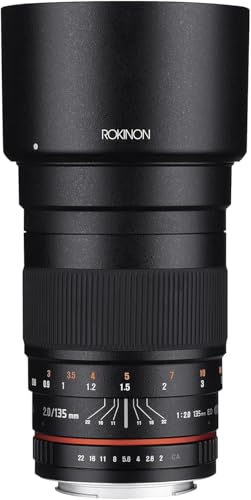
Rokinon 135mm f/2.0 Telephoto Lens
Best for: Portrait photography and video with Canon DSLRs
- Recommended Usage
- Photography, Photography & Video
- Lens Mount
- Canon
- Focal Length
- 135mm
- Maximum Aperture
- F2.0
- Sensor Format
- Full frame, APS-C
- Lens Type
- Telephoto
This Rokinon 135mm F2.0 lens is a telephoto option for Canon DSLR cameras. It features a maximum aperture of f/2.0 and a minimum focusing distance of 2.6 ft. The design includes one extra-low dispersion element to reduce chromatic aberrations. You get nine diaphragm blades for smooth bokeh. It weighs 1.8 pounds and measures 4.09 inches in length. This lens suits photographers and videographers seeking a dedicated telephoto perspective.
- F2.0 maximum aperture for low light
- 135mm focal length for telephoto reach
- 9-blade diaphragm for smooth bokeh
- ED element reduces chromatic aberration
- Compatible with full frame and APS-C sensors
- 1.8 pounds weight is heavier than many standard lenses
- 2.6 ft minimum focus distance limits close-up detail
- Manual focus only with no autofocus motor
- You want a dedicated telephoto lens for portraits
- You shoot video and need smooth background blur
- You use Canon DSLR cameras
- You need fast autofocus for action shots
- You prefer a compact and lightweight lens
- You shoot with mirrorless Sony or Nikon cameras
Verdict: Rokinon 135mm F2 Telephoto Lens is a solid choice for Canon users who prioritize optical quality and aperture speed over convenience. It fits those who want to isolate subjects with a long focal length and do not mind manual operation.

Sony E 15mm f/1.4 G APS-C Lens
Best for: APS-C video creators needing wide angle
- Recommended Usage
- Photography, Photography & Video
- Lens Mount
- E-mount
- Focal Length
- 15mm
- Maximum Aperture
- f/1.4
- Sensor Format
- APS-C
- Lens Type
- Wide-angle prime
This Sony E-mount prime lens offers a 15mm focal length and a bright f/1.4 aperture for APS-C cameras. Its compact build and fast autofocus make it suitable for both photography and video. The constant length design aids handling, while the aperture ring allows for precise control. It is a solid option for creators needing wide perspectives and low-light performance.
- Large f/1.4 maximum aperture for low light
- Fast, precise autofocus with two linear motors
- Constant lens length during focusing for balance
- Aperture ring with silent click-off switch
- Heavier at 13.3 ounces compared to lighter primes
- Limited to APS-C sensor format only
- You shoot with Sony E-mount APS-C cameras
- You need a wide angle for video content
- You want fast autofocus for moving subjects
- You use full-frame cameras without crop mode
- You prefer zoom lenses for versatility
- You need a telephoto perspective
Verdict: Sony E 15mm f/1.4 G Wide Angle Lens fits APS-C video creators who need a fast, compact prime. It delivers wide perspectives and reliable tracking for dynamic shots.

Nikon NIKKOR Z 105mm f/2.8 VR S
Best for: dedicated macro photography on Nikon Z
- Recommended Usage
- Photography, Photography & Video
- Lens Mount
- Nikon Z
- Focal Length
- 105mm
- Maximum Aperture
- f/2.8
- Sensor Format
- Full-Frame
- Lens Type
- Macro
This full-frame Nikon Z-mount lens is built for macro work. It offers 1:1 maximum magnification and an 11.4-inch minimum focus distance. The f/2.8 aperture and Vibration Reduction help you capture sharp details in low light. The S-Line construction includes weather sealing. It suits photographers who need precise close-up imaging for products or nature.
- 1:1 maximum magnification for true macro detail
- f/2.8 maximum aperture for better light gathering
- Vibration Reduction image stabilization
- Weather-sealed S-Line construction
- Heavier at 2 pounds compared to lighter primes
- Fixed 105mm focal length limits versatility
- Longer minimum focus distance than shorter macro lenses
- You need true 1:1 magnification for product shots
- You shoot with a Nikon Z full-frame camera
- You require weather sealing for outdoor macro work
- You use a Sony E-mount camera system
- You need a wide-angle perspective for landscapes
- You prioritize lightweight gear for travel
Verdict: Nikon NIKKOR Z 105mm f/2.8 VR S Macro delivers precise macro capabilities for Nikon Z users. It fits photographers who need dedicated close-up performance and weather resistance on full-frame bodies.
Specifications side by side
| Spec | Rokinon 135mm f/2.0 Telephoto Lens | Sony E 15mm f/1.4 G APS-C Lens | Nikon NIKKOR Z 105mm f/2.8 VR S |
|---|---|---|---|
| Lens Mount | Canon | E-mount | Nikon Z |
| Focal Length | 135mm | 15mm | 105mm |
| Maximum Aperture | F2.0 | f/1.4 | f/2.8 |
| Sensor Format | Full frame, APS-C | APS-C | Full-Frame |
| Lens Type | Telephoto | Wide-angle prime | Macro |
| Image Stabilization | – | – | Vibration Reduction |
| Minimum Focus Distance | 2.6 ft. | – | 11.4-inch |
| Maximum Magnification | – | – | 1:1 |
| Recommended Usage | Photography, Photography & Video | Photography, Photography & Video | Photography, Photography & Video |
| Color | Black | Black | – |
| Sensor Size | – | APS-C Sensor | – |
| Intended Use | Video | Video | Video |
| Dimensions | 3.2 × 4.09 × 4.09 inches | 12.6 × 11.7 × 7.28 inches | 11 × 5 × 5 inches |
| Weight | 1.8 pounds | 13.3 ounces | 2 pounds |
| Size | 77mm | 3.43 | – |
| Model | 135M-C | SEL15F14G | 20100_AG2_1 |
Choosing the Right Lens Specs
Match Sensor Format
Check the lens attributes for the intended sensor format. The Sony E 15mm f/1.4 G is designed for APS-C sensors. This ensures the image circle covers your camera’s sensor completely. Using a full-frame lens on an APS-C body works, but an APS-C lens on a full-frame body causes black corners. Verify the mount type matches your camera. The Sony E mount fits Sony bodies, while the Nikon Z mount is for Nikon Z cameras. Matching these specs prevents compatibility errors and ensures proper image coverage.
Prioritize Aperture Speed
Look at the maximum aperture value for low-light performance. A lower f-number means a wider opening. The Sony E 15mm f/1.4 G offers an f/1.4 aperture. This allows more light to hit the sensor, which is useful for indoor video or dim environments. The Rokinon 135mm f/2.0 provides an f/2.0 aperture. This is sufficient for portrait photography but less flexible in dark settings. Compare these numbers to determine if you need a faster lens for your typical shooting conditions.
Consider Focal Length
Select a focal length that matches your subject distance. The Rokinon 135mm f/2.0 is a telephoto lens. It compresses backgrounds and isolates subjects, making it ideal for portraits. The Sony E 15mm f/1.4 G is a wide-angle lens. It captures more of the scene, which suits video creators who need wide perspectives. The Nikon Z 105mm f/2.8 is a macro lens. It allows close focusing for detailed shots. Choose the length that fits your composition style.
Check Lens Weight
Review the weight specification for handling comfort. The Sony E 15mm f/1.4 G weighs 13.3 ounces. This light weight makes it easy to hold for long video sessions. The Rokinon 135mm f/2.0 weighs 1.8 pounds. This is heavier and may require a tripod for steady shots. The Nikon Z 105mm f/2.8 VR S weighs 2 pounds. Heavier lenses can cause fatigue during handheld use. Consider your shooting style and whether you need a lightweight option for mobility.
Verify Intended Use
Ensure the lens supports your primary activity. The Sony E 15mm f/1.4 G lists video as its intended use. It also supports photography. The Rokinon 135mm f/2.0 is marked for video use as well. The Nikon Z 105mm f/2.8 VR S is a macro lens. It is optimized for close-up photography but also supports video. Check the attributes to confirm the lens meets your specific needs. A lens designed for one purpose may not perform optimally for another.
Frequently asked questions
Which lens is best for portrait photography on Canon DSLRs?
The Rokinon 135mm f/2.0 Telephoto Lens is the top choice for Canon users seeking portrait capabilities. Its 135mm focal length allows you to isolate subjects effectively against a blurred background. The f/2.0 aperture provides sufficient light gathering for shallow depth of field, which is essential for professional-looking portraits.
What is the smallest lens for APS-C video cameras?
The Sony E 15mm f/1.4 G is the most compact option listed for APS-C bodies. It weighs only 13.3 ounces and features a wide-angle perspective ideal for dynamic video shots. Its small form factor makes it easy to handle for handheld recording or vlogging without adding significant bulk to your rig.
Can I use this lens for macro photography?
Yes, the Nikon NIKKOR Z 105mm f/2.8 VR S is designed specifically for macro work. It offers dedicated close-up performance on full-frame Nikon Z cameras. The f/2.8 aperture and 105mm focal length allow you to capture detailed textures while maintaining a comfortable working distance from your subject.
Which lens has the fastest maximum aperture?
The Sony E 15mm f/1.4 G features the fastest maximum aperture at f/1.4. This specification allows more light to reach the sensor compared to the f/2.0 and f/2.8 options. A faster aperture helps you shoot in low-light environments without increasing ISO, resulting in cleaner images and video footage.
Is there a weather-sealed option for outdoor shooting?
The Nikon NIKKOR Z 105mm f/2.8 VR S is built with weather resistance. This feature protects the lens from dust and moisture during outdoor sessions. It is particularly useful for photographers who need reliable performance in challenging environmental conditions while shooting macro or telephoto subjects on full-frame bodies.
How much does the heaviest lens weigh?
The Rokinon 135mm f/2.0 Telephoto Lens is the heaviest item at 1.8 pounds. Its substantial weight may require a sturdy tripod for stable handheld video or long exposure photography. The Nikon NIKKOR Z 105mm follows closely at 2 pounds, while the Sony E 15mm remains the lightest at 13.3 ounces.


